
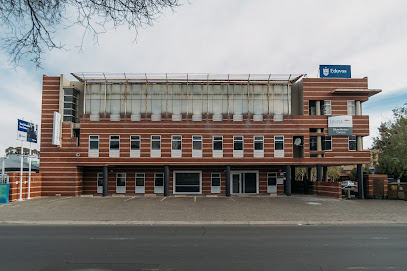
Eduvos Bloemfontein Campus is a Private educational institutions establishment in Bloemfontein, Free State, South Africa
Bloemfontein
Free State
9301
South Africa
Curriculum
Eduvos 현재 operates a multi-faculty approach across its campuses, with offerings spanning the Arts, Commerce, Law, Technology and Applied Sciences. At its Bloemfontein Campus in the Free State, the curriculum is designed to align with industry needs while maintaining academic rigour. The university emphasises an applied, practical orientation alongside theoretical study to prepare graduates for professional environments and further study.
Programmes are substantial in scope, covering undergraduate and postgraduate levels, and subject to organisational structures that reflect the broader Eduvos framework. Students can expect programmes that integrate core disciplinary knowledge with transferable skills such as critical thinking, communication, research methods, problem solving and teamwork. The curriculum is developed to foster employability through real-world relevance, problem-based learning and project work that connects classroom learning with community and industry contexts.
Within the portfolio, there is a clear emphasis on areas of study that span humanities and social sciences, business and management, and professional disciplines. The Bloemfontein Campus participates in this broader framework, subject to local delivery modes and available pathways. While detailed module lists and specific course titles vary by programme, the overall approach centres on preparing students for both professional assessment and continued academic progression.
In terms of delivery, several Eduvos qualifications are offered in modes that accommodate diverse study needs. Some Bachelor degrees are available as full-time campus programmes, while certain degrees also feature distance or blended modes, including online components for selected tracks. This enables learners to combine on-site campus activities with flexible delivery when appropriate, subject to programme requirements. The institution emphasises quality teaching and learning practices across these formats to maintain consistency of academic standards.
Short courses and professional training forms part of the wider Eduvos curriculum strategy. While exact short courses are not itemised on the published pages, the organisation highlights opportunities for targeted professional development and continuing education. Prospective students and professionals may encounter bite-sized offerings that complement degree studies or provide focused skill development aligned with contemporary work environments.
Distinctive learning resources noted within the Eduvos framework include access to faculties such as the School of Future Technology, the School of Arts and Design, and the Graduate School of Accounting, along with specialist facilities and clinics that support applied study. For example, in related disciplines, the existence of practical clinics and applied-learning opportunities underlines a commitment to experiential education and professional practice readiness. Access to these resources is designed to enhance practical understanding, enable live case work and foster industry connections.
Student support and success services form an integral part of the curriculum experience. While the public materials do not enumerate every service detail for the Bloemfontein Campus, the overarching Eduvos model includes guidance designed to support academic progression, personal development and career preparation. Students can expect access to academic advising, study resources and other support mechanisms that facilitate positive learning outcomes and progression through their chosen programme.
Overall, the Curriculum at Eduvos Bloemfontein Campus reflects the institution’s commitment to a broad, practice-informed education across multiple disciplines. It aims to provide scalable pathways from pre-degree and higher certificate offerings through to undergraduate and master’s studies, with attention to employability, continued learning and global perspectives. For prospective students seeking to understand entry routes, exact modules, and campus-specific delivery options, it is advisable to consult the official Eduvos programme pages and campus communications available through the main website.
- Faculties represented within Eduvos include Applied Science, Commerce, Law, Technology, and Humanities.
- Delivery modes include campus-based study with potential blended or distance components for certain programmes.
- Distinctive learning resources and practical opportunities are highlighted across faculties, including clinics and applied learning facilities.
Faculties and Branches
Eduvos presents a structured framework of faculties, schools and programmes designed to support a diverse range of
disciplines at tertiary level. The information available for Eduvos Bloemfontein Campus situates the institution within a
broader organisational map that includes five primary faculties, each hosting a spectrum of departments and related
programmes. The overarching arrangement emphasises academic specialisation alongside pathways for professional development.
Within the formal taxonomy, the following faculties are highlighted:
- Applied Science
- Commerce
- Law (including the Eduvos Law Clinic as a dedicated clinical resource)
- Technology
- Humanities
Supporting these faculties are specialist schools that curate programme emphasis in focused domains. The schools listed
include:
- School of Future Technology
- School of Arts and Design
- School of Marketing
- Graduate School of Accounting
Across the Eduvos network, programmes are organised by degree level and field of study. The available offerings include
various bachelor’s degrees and advanced programmes, with courses spanning arts, business, law, design and technology
subjects. Representative examples of degree programmes include:
- Bachelor of Arts in fields such as Communication Science, English, Industrial Psychology, Linguistics, Politics,
Economics, Media Studies and related combinations - Bachelor of Business Administration
- Bachelor of Commerce, including Accounting and Human Resource Management specialisations
- Bachelor of Arts in Graphic Design
- Postgraduate and masters options are accessible under the broader programmes umbrella
Where available, the materials indicate the relationship between faculties and academic offerings by showing department
groupings and degree pathways. Each faculty appears aligned with specific schools and a curated set of programmes, aimed
at blending theoretical learning with practical application. Where learners seek professional accreditation or industry
relevance, the presence of dedicated units such as the Eduvos Law Clinic signals access to experiential learning within the
law discipline.
Details about the Bloemfontein Campus itself—such as campus-specific facilities, department locations, or branch
distinctions—are not explicitly itemised in the accessible content. The information primarily maps the institutional
structure at a high level, presenting the internal organisation of faculties, schools and available degrees and related
offerings. Prospective students or collaborators may wish to consult the main Eduvos site for current programme lists and
campus-specific announcements at https://www.eduvos.com/.
For those seeking more granular information about particular programmes or the exact campus arrangement in Bloemfontein, links
to the faculties and schools are provided on the main site, including the pages for Applied Science, Commerce, Law, Technology
and Humanities, as well as the School pages and the broad programme catalogue. These resources offer the most up-to-date
descriptions of curriculum structure, entry requirements, and progression routes within the Eduvos network.
Registration Details
Eduvos Bloemfontein Campus, situated in Bloemfontein, Free State, South Africa, provides prospective students with a clear path to join its various programmes. The campus operates within the broader Eduvos framework, which presents information about programmes, admissions pathways and related support through the official Eduvos website. This section offers an independent overview of the registration process as it is presented by Eduvos’ public materials, with attention to steps typically involved in applying and pursuing study at the Bloemfontein Campus.
Registration and application process overview
Applicants are advised to begin with an online exploration of available programmes and entry pathways via Eduvos’ programme pages. The site categorises offerings by degree-type and mode of study, enabling prospective students to identify options that align with interests and prior qualifications. While exact application timelines or campus-specific deadlines are not stated in the available materials, the general approach emphasises selecting a suitable programme and then following the institution’s admissions route through the official channels provided on the Eduvos site.
Where to apply
Information about applying can be found through the Eduvos programmes and admissions resources linked from the site. Interested applicants can consult the following areas for guidance and access to application pathways:
Eligibility and entry requirements
The available public materials outline that programmes come with defined entry routes aligned to degree-type and campus offering. Specific eligibility criteria are not enumerated in the posted content for Eduvos Bloemfontein Campus. Prospective applicants are encouraged to review the programme pages and the general admissions information on the Eduvos site to confirm whether prior qualifications, language requirements or other conditions apply to a chosen course of study.
Documents typically required
The public materials do not provide a definitive list of documents for registration. In line with common practice, prospective students should be prepared to supply standard academic records and identification as part of the application process, but no explicit document list is stated in the available content for this campus. Applicants are advised to consult the official programme and admissions pages for any stated documentation requirements.
Contact and support channels
The provided materials do not include direct contact details for the Bloemfontein Campus. General assistance and information about applying are available through the Eduvos website. Interested parties may use the site’s programme and admissions pages to access further guidance and any contact options that may be posted there.
Notes for prospective students
As the content is presented in a read-only, offline format, it is recommended to navigate to the live Eduvos site for the most current information on application steps, eligibility, required documentation and any campus-specific instructions. The Eduvos platform hosts the wider range of faculties, schools and programmes, which can inform a well-prepared application for Bloemfontein Campus study.
Sorry, no records were found. Please adjust your search criteria and try again.
Sorry, unable to load the Maps API.
Education and Educational Resources in Bloemfontein
Bloemfontein, located in the Free State, combines a broad spectrum of learning environments that cater to diverse educational needs. The city generally offers a mix of government-supported institutions and private providers, spanning primary and secondary schools, further education colleges, higher education establishments, and specialised training centres. This range supports learners from early years through to advanced study and vocational preparation, reflecting the emphasis placed on accessible education within the region.
In terms of schools, families commonly encounter a variety of public and independent options. Schools typically deliver curricula aligned with national standards and offer a mix of academic and practical subjects. Many institutions emphasise core literacy and numeracy, alongside science, technology, engineering and mathematics (STEM) disciplines, humanities, languages, arts and physical education. Extracurricular activities, from sport to cultural programmes, often play a central role in school life, facilitating well-rounded development and opportunities for talent discovery.
Further education options include colleges and vocational training centres that provide certificate and diploma programmes across sectors such as business studies, information technology, hospitality, engineering trades, health studies and community services. These facilities commonly cater to learners seeking practical skills, work-ready competencies or a stepping-stone to higher education. Modular programmes and part-time routes are frequently available to accommodate adult learners, working individuals and those balancing family commitments.
Higher education in the city tends to focus on a mix of undergraduate and postgraduate study. Universities in Bloemfontein often offer programmes spanning the arts, sciences, social sciences, business and law, alongside professional degrees. Access pathways typically include competitive admissions processes, with consideration given to previous academic results and, in some cases, relevant work or study experience. Prospective students are generally guided through application cycles, with information on financial aid, housing, and support services provided through central offices or student services units.
Learning support and student services form a crucial part of the educational ecosystem. Institutions commonly provide academic advisory services, writing and study skills assistance, language support for multilingual learners, and tutoring programmes. Disability services and inclusive education initiatives are frequently available to ensure accessibility and accommodation for students with diverse needs. Mental health and wellbeing resources, career guidance, and employability support tend to be integral components, helping learners plan study paths and transition into employment or further study.
Facilities and resources are a notable feature of Bloemfontein’s educational landscape. Libraries and study centres offer access to print and digital collections, quiet study spaces, and research support. Laboratories for science and technology subjects, workshops for applied disciplines, and robust information technology infrastructure are commonly found across institutions. Accommodation options, including on-site halls of residence or university/college-owned housing, support students relocating from other areas. Sports facilities, fitness centres and recreation spaces are often available to promote physical well-being and community engagement.
Typical pathways for learners involve a combination of organised admissions procedures, registration processes and orientation activities. Prospective students are usually required to submit an application, supporting documents and any relevant assessments within specified timelines. Once admitted, students may engage with course advisers to confirm module choices, discuss progression requirements and plan study across semesters. Planning ahead for accommodation, finance, and practical matters such as transport can help ensure a smoother transition into higher education or vocational training.
Overall, Bloemfontein provides a comprehensive educational milieu, with options to suit a broad spectrum of interests, abilities, and circumstances. The city supports learners and families by presenting diverse programmes, practical training opportunities, and a framework of services designed to promote academic achievement, personal growth and successful transitions into careers or further study.