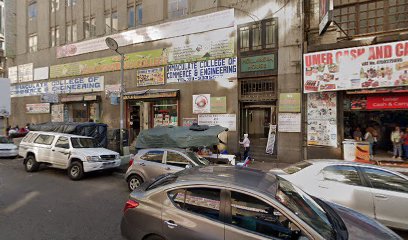
Saint Ignatious College is a Private colleges establishment in Johannesburg, Gauteng, South Africa
Johannesburg
Gauteng
127 Helen Joseph St
South Africa
Curriculum
Saint Ignatious College presents a diverse curriculum across several faculties, each designed to equip learners with practical skills aligned to the National Qualifications Framework (NQF) and focused on employability. The college emphasises hands-on learning, contemporary theory, and workplace-facing modules, with programmes structured to suit both full-time and part-time study for greater accessibility.
Within the Faculty of Health Studies, the college offers short, focused credentials that lead to foundational roles in care and health promotion. The Social Auxiliary Worker qualification operates at NQF Level 5 and spans around 12 months, combining theory with practical work placements to prepare learners to support professional social workers and engage in community well-being. The Health Promotion Officer qualification, at NQF Level 3 and running for about a year, centres on promoting wellness, educating communities, and linking individuals to health resources. A shorter pathway, Home Based Personal Care at NQF Level 2, targets entry into caregiving in aged care or private homes under supervision, over roughly six months. These offerings reflect the college’s emphasis on practical preparation for frontline roles in social care, community health and basic medical support.
The Education faculty contains programmes aimed at early development and foundational pedagogy. Early Childhood Development lasts around 12 months at NQF Level 4, with a focus on nurturing and developing young learners during the formative years. The curriculum emphasises skills suitable for those pursuing entry-level positions in early education, recognising the value of foundational training in nurturing critical early learning experiences.
The Agricultural studies pathway presents sector-specific short courses that tackle practical farming skills across 6 to 12 months, with opportunities at NQF Levels 2 and 3. Learners can select from areas such as Mixed Farming, Plant Production, Animal Production, Poultry Production, and general Farming courses. The approach centres on practical application and real-world agricultural contexts, enabling graduates to pursue hands-on roles in farming operations or related industries.
Across the Business Studies faculty, a suite of N4–N6 programmes provides foundational business and administrative training over approximately 18 months per subject area. Core offerings include Human Resources Management, Business Management, Financial Management, Travel and Tourism, Management Assistant (Office Administration), Public Management, Marketing Management, Hospitality and Catering Services, and Sound Engineering. Each pathway is designed to introduce learners to essential concepts, with a view to enabling progression into related careers such as HR roles, office administration, marketing, hospitality management, and audio production.
Engineering Studies also follows the N4–N6 framework, comprising Electrical Engineering, Mechanical Engineering, Civil Engineering, and Boiler Making, each structured over about 12 months. The curriculum emphasizes foundational engineering principles combined with practical, industry-relevant skills geared toward entry-level positions in engineering, construction, and manufacturing sectors.
The college supports flexible delivery and entry pathways, underscored by a commitment to accessible learning. In addition to full-time study, the college notes flexible learning options, including part-time study, which can help students balance study with work or other responsibilities. The prospectus and course pages indicate a blend of classroom instruction with practical components and workplace-based experiences, areas where the college seeks to foster applied competencies alongside theoretical understanding.
Short courses and professional training are complemented by continuing education elements and admission routes that accommodate varied backgrounds. Short courses and extended programmes are introduced as practical responses to industry demand, enabling individuals to upskill or pivot career directions with modules that emphasise transferable competencies, such as communication, problem solving, teamwork and professional conduct. The curriculum framework emphasises alignment with recognised qualifications, ensuring that learners can articulate their qualifications within broader education and training pathways.
Online and blended elements arise in the broader delivery model of Saint Ignatious College, including online application processes and access to online information resources. The institution provides clear pathways for applicants to register and begin study, with accessible guidance through its forms and information portals. While the primary content highlights face-to-face tuition and one-on-one tutoring delivered by experienced tutors, flexibility in study modes remains a defining feature of the college’s approach to curriculum delivery.
For prospective students seeking more detail on specific modules, progression routes, or entry requirements for each programme, the college provides dedicated pages and downloadable information. Visitors are encouraged to consult the corresponding course pages and the online application form for the most up-to-date information and to understand how particular study options may fit individual career plans. The curriculum is presented as practical, career-oriented, and community-focused, designed to equip learners with transferable skills for further study or employment within healthcare, education, agriculture, business, and engineering sectors.
Faculties and Branches
Saint Ignatious College in Johannesburg presents a structured offering across several faculties, each aligned with practical pathways in vocational and professional education. The institution’s programmes span health studies, education, agriculture, business, and engineering, with courses designed to combine theoretical foundations with applied skills to support employability and further study.
The Faculty of Health Studies delivers short courses and qualifications focused on social care and health promotion. Programmes include Social Auxiliary Work (NQF Level 5), which equips learners to assist social workers and contribute to community well‑being, as well as Health Promotion Officer (NQF Level 3) and Home Based Personal Care (NQF Level 2). These offerings are described as foundational routes into healthcare and social services, including opportunities to pursue related professional pathways through practical placements and related study guides.
The Faculty of Education provides Early Childhood Development training, targeting the development of foundational skills for nurturing children in formal education settings. The emphasis is on preparing learners for rewarding careers in early education, alongside the health and social care pathways described in other faculties.
Within the Faculty of Agriculture & Farming, practical courses cover a range of agricultural disciplines. The curriculum is presented as 6–12‑month programmes at NQF Levels 2 and 3, with emphasis on Mixed Farming, Plant Production, Animal Production, Poultry Production, and general Farming. These courses are described as enabling practical farm skills for real agricultural careers.
The Faculty of Business Studies N4–N6 encompasses several management‑focused disciplines. Areas include Human Resources Management, Business Management, Financial Management, Travel and Tourism, Management Assistant (Office Administration), Public Management, Marketing Management, Hospitality and Catering Services, and Sound Engineering. The breadth of offerings is positioned to support transitions into administrative, managerial, financial, tourism, communications, and related roles, with many programmes spanning 18 months of study and designed to prepare learners for entry‑level or intermediate positions.
The Faculty of Engineering Studies N4–N6 features programmes in Electrical, Mechanical, and Civil Engineering, as well as Boiler Making. These courses aim to establish foundational engineering knowledge alongside practical skill development for infrastructure projects, manufacturing, and related industries.
Across these faculties, the college coordinates with several campuses and branches to widen access. The organisation highlights six branches nationwide, and the contact page confirms campuses in Johannesburg, Pretoria, Witbank, KwaMhlanga, and Polokwane, among others. This geographical spread underlines an intent to provide regional access to the college’s programmes and student services.
Student services and study pathways are framed around a mix of applied qualifications and industry‑relevant courses, with online application facilities and information pages available for more detail. The site also notes accreditation and registration structures, including private provider status and recognition by quality assurance bodies, which frame the relationship between faculties and the wider national qualifications framework.
- Johannesburg campus: main location for programmes and student services.
- Pretoria campus: regional access point for courses and practical placements.
- Witbank campus: additional study hub extending practical training opportunities.
- KwaMhlanga campus: further regional presence for learners in surrounding areas.
- Polokwane campus: northern basin access for agricultural and engineering studies, among others.
For prospective students, the faculties collectively map to a broad spectrum of qualifications that address both vocational training and foundational professional programmes, with campuses designed to support learning, assessments, and potential workplace‑based experiences. Further details on each course, including duration, levels, and progression opportunities, are available via the college’s website.
Website reference: Saint Ignatious College
Registration Details
Saint Ignatious College in Johannesburg provides an overview of its registration and application pathway through its online infrastructure. Prospective learners are guided to submit their application via the college’s dedicated online application form, accessible from the college’s website. The primary entry point for applications is the online form, which is linked directly from the institution’s pages and is described as the secure method for submitting an application.
Overview of the application process
- Access the online application form via the college’s site. The form is presented as the central mechanism for submitting registrations and inquiries.
- Complete the registration process through the online platform, which is described as the secure submission channel for applications.
- Following submission, further steps or communications may be conveyed through the college’s online channels or campus contacts, subject to the college’s administration schedule.
Where to apply
Applications are facilitated through the college’s online form. Direct access is provided via the following link to the online application form: Apply now. This form is referenced on multiple programme pages and is described as the method for submitting registration details.
Programme-specific context and entry points
Several faculties and courses are listed on the college’s site, with application prompts visible on programme pages. For example, Health Studies, Education, Agriculture & Farming, and Business Studies programmes frequently include an “Apply now” option that routes to the online form. When exploring a particular course, the “Apply now” link should be used to initiate the registration process for that programme.
Eligibility and entry requirements
Where stated, admission requirements are presented for specific courses. For instance, the Social Auxiliary Worker qualification lists the following entry criteria: a Grade 12 Certificate or Equivalent, and an identified interest in assisting others. Additional documents are outlined in the course-specific admission details. In the case of the Health Promotion Officer and related qualifications, the site describes general progression into healthcare and community health roles, with duration and aims rather than rigid deadlines.
Typical documents and information
The college’s admission notes indicate that certain documents are required for registration when applicable. These commonly include certified copies of qualifications, proof of identity, and passport photographs, alongside an example registration fee in the course-admission context. The precise document list and any registration fee are stated on the course-specific admission details, and applicants are advised to consult the relevant course page for exact requirements. The available content does not specify universal deadlines, but it does emphasise the online submission pathway as the primary route for registrations.
Contact and support channels
The college maintains campus contact points for clarification and assistance. Within the Johannesburg campus information, locations and campus access are provided, and online contact options are suggested through the site’s communications. Where available, a WhatsApp contact is provided for direct outreach to the college’s administration. Visitors or prospective applicants can use the site’s contact references to obtain more precise guidance or to arrange follow-up queries related to registration.
Notes for prospective applicants
Since the site presents a central online application mechanism, it is recommended to use the official online form for registrations and to refer to course-specific pages for any programme-specific admission criteria, documents, or supplementary steps. The college’s online presence also highlights the breadth of offered programmes, with links to further information on each faculty and the corresponding application pathway.
Sorry, no records were found. Please adjust your search criteria and try again.
Sorry, unable to load the Maps API.
Education and Educational Resources in Johannesburg
Johannesburg, a major urban centre in Gauteng, presents a diverse landscape of educational options that cater to a wide range of learners. From primary and secondary schooling to higher education and specialised training, the city supports families seeking accessible, varied pathways through education. Learners frequently encounter a mix of traditional school settings, further education and training (FET) colleges, universities, and independent training centres, each contributing to a comprehensive educational ecosystem.
Schools in the area typically offer curricula aligned with national and provincial guidelines, with some institutions placing emphasis on bilingual or multilingual instruction to reflect the city’s diverse communities. Secondary education commonly leads into further study through senior certificates, national diplomas, or A-level style routes, depending on the school’s framework. Additional learning support services, such as literacy and numeracy programmes, language assistance, and guidance counselling, are frequently available to assist learners at varying levels of ability. Strong neighbourhoods often host primary and high schools that integrate community engagement into their routines, reinforcing the link between schooling and local development.
Higher education and technical training in Johannesburg span universities, universities of technology, and dedicated training centres that focus on practical skill development. Programmes commonly cover disciplines such as business, engineering, health sciences, information technology, creative arts, and social sciences. Flexible study modes, including full-time, part-time, and distance options, enable access for working individuals or those balancing family responsibilities. Local institutions frequently emphasise work-integrated learning, internships, and industry partnerships to facilitate real-world experience and employability upon graduation.
Training centres and vocational schools play a notable role by offering short courses, certificates, and diplomas tailored to specific sectors. These pathways are often designed to respond to labour market needs and provide practical, hands-on instruction in areas such as ICT, hospitality, construction, and healthcare support. Learners may find programmes that enable rapid progression into entry-level roles or further study, depending on personal goals and prior qualifications.
Support services across education providers typically extend beyond academic instruction. On-campus resources commonly include libraries with study spaces and quiet zones, computer laboratories, and printing facilities. Learner support may incorporate academic tutoring, study skills workshops, language support, and mentoring programmes. Student services often address accommodation assistance, wellness resources, financial guidance, and career development advice, helping learners to navigate registration, financing options, and progression plans.
Facilities frequently reflect the urban context, with access to well-equipped laboratories, dedicated science and technology spaces, and sports facilities that support a range of physical activities. Some institutions offer residential accommodation or partnered housing for students relocating to the city, contributing to a sense of community and stability during study. Community education hubs and public libraries at neighbourhood level may provide additional study spaces, resource-sharing, and information literacy support for learners seeking independent study opportunities outside formal classrooms.
Typical pathways include initial school-leaving certificates followed by tertiary study options, professional diplomas, or undergraduate degrees. Admissions processes generally require compliance with local education authority regulations, with emphasis placed on meeting required academic standards and meeting application deadlines. Visual and practical portfolios may be used for certain programmes, while others rely on examination results and controlled assessment. Guidance and career services can help learners map out possibilities, outline entry requirements, and identify suitable progression routes aligned with personal strengths and career ambitions.
For families exploring education in Johannesburg, the city offers a broad spectrum of options that support diverse learning journeys. The combination of traditional schooling, modern higher education, and practical training creates a robust environment where learners can pursue academic achievement, professional development, and lifelong learning within reach of home bases across Gauteng.