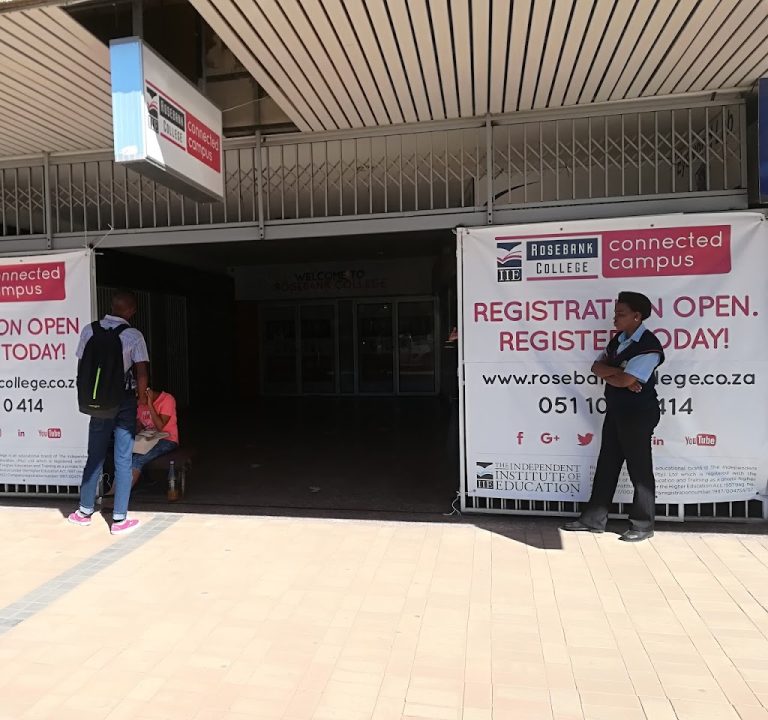
Rosebank College Bloemfontein Campus is a Colleges establishment in Bloemfontein, Free State, South Africa
Bloemfontein
Free State
9301
South Africa
Curriculum
Rosebank College Bloemfontein Campus delivers a portfolio of IIE qualifications designed to align with industry needs while offering flexible study options. The college supports learners across multiple faculties, including Commerce, Finance & Accounting, Law, Education, Humanities and Social Science, and Information and Communications Technology. The breadth of offerings enables students to pursue pathways in higher certificates and postgraduate study, subject to programme availability at the Bloemfontein campus as part of the wider Rosebank College network.
Programmes/levels are structured to progress from foundational qualifications to more advanced studies. Prospective students can explore a range of IIE Higher Certificates and Postgraduate Qualifications, with study modes that emphasise accessibility. The institution’s framework is designed to facilitate career-oriented achievement, incorporating practical application within each discipline while maintaining academic rigour. While specific course lists, durations, accreditation statements or entry requirements are not provided here, the broad spectrum of faculties indicates opportunities across business, technology, education and the humanities.
Curriculum design emphasises applied learning and real-world relevance. Students are encouraged to engage with modules that translate theory into practice, supporting employability through case studies, simulations and project work. The online information sessions and admissions pathways are highlighted as accessible routes to understanding programme specifics, module choices and registration steps. The approach supports learners who prefer blended or online study formats, reflecting Rosebank College’s commitment to flexible delivery alongside campus-based study.
Short courses and professional training are positioned as routes to upskilling or refreshing knowledge within the IIE framework. While particular short programmes are not itemised in the available material, the organisation’s emphasis on practical, career-focused qualifications suggests a willingness to incorporate short modalities that complement degree-level study. For those seeking bite-sized credentials or targeted expertise, the curriculum ethos centres on relevance to current industry practice and ongoing professional development.
Online and blended options are explicitly supported through the institution’s online study offerings. Learners can begin or continue studies via remote access, with information sessions designed to help prospective students understand online registration, module selection and payment plans. This flexibility is complemented by on-campus provision, reflecting a blended learning ecosystem that accommodates diverse learning preferences and life circumstances.
Distinctive learning resources are suggested by the site through its digital and information systems. The presence of online information sessions, the ability to register and manage modules online, and the cashless campus operations indicate an integrated student experience that combines digital learning environments with structured administrative processes. These elements contribute to a streamlined curriculum journey from application to graduation.
Student support services, while not exhaustively listed in the available content, are implied by the existence of online admissions information, payment systems and campus contacts for various locations. The directory-style structure of the site points to a networked support framework designed to assist learners through admissions, registration, fee payments and general customer services. The emphasis on timely communication, clear application steps and payment options supports a network of services that underpins the curriculum experience.
For families and prospective students researching Rosebank College Bloemfontein Campus, the curriculum presentation highlights core strengths: a university-level pathway through IIE qualifications, cross-disciplinary access via multiple faculties, and flexible study formats to accommodate different learning needs. The institution’s selective focus on career preparedness, combined with online information sessions and a clear registration process, offers a practical route to educational advancement within the South African higher education landscape.
- Areas of study across IIE faculties: Commerce, Finance & Accounting, Law, Education, Humanities & Social Science, Information and Communications Technology.
- Qualification types: IIE Higher Certificates and IIE Postgraduate Qualifications.
- Delivery modes: campus-based study with online information sessions and online registration options; emphasis on blended and online study where applicable.
Faculties and Branches
Rosebank College Bloemfontein Campus sits within a network of IIE faculties that collectively support a broad range of professional and vocational programmes. The Bloemfontein campus aligns with the IIE framework, offering access to several recognised faculties that structure the college’s qualifications and study pathways.
The following faculties are featured across the Rosebank College portfolio, each supporting a spectrum of higher education qualifications and professional qualifications:
- IIE Faculty of Commerce
- IIE Faculty of Finance & Accounting
- IIE Faculty of Law
- IIE Faculty of Education
- IIE Faculty of Humanities and Social Science
- IIE Faculty of Information and Communications Technology
In addition to the Bloemfontein campus, the Rosebank College network includes other branches and centres to serve prospective and current students. Notable campuses include the Nelson Mandela Bay campus and the Mbombela (Nelspruit) campus, each part of the same national framework that supports online study and localised student services. This structure allows students to pursue similar qualifications across multiple locations while benefiting from campus-specific arrangements and online information sessions.
The relationship between faculties, campuses and programmes is designed to enable access to a diverse slate of qualifications, including higher certificates and postgraduate options. Information on course types and delivery modes is presented online, with pathways to qualification exploration and application managed through the college’s admissions and qualifications pages. For prospective students, the online information session and the straightforward application-registration process provide practical avenues to begin study at either the Bloemfontein campus or another Rosebank College site.
Overall, the faculties at Rosebank College Bloemfontein Campus support a structured programme of study across commerce, finance and accounting, law, education, humanities and social sciences, and information technology. The campus network extends the reach of these disciplines through additional regional campuses, while the institution’s online offerings ensure flexible access to education and student services across locations.
Further information about qualifications, study modes and admissions can be found via the Rosebank College website, including links to specific faculties, the online application process, and the broader campus network.
Registration Details
Rosebank College Bloemfontein Campus is presented to prospective students as part of a wider national network of IIE institutions. The admissions pathway is described as a two-phase process, beginning with an application for admission and culminating in the registration of modules and payment arrangements once a place is offered.
Phase One: Application for Admission. The initial step requires the submission of an application form for admission. Applicants must upload copies of identifying documents and the relevant senior certificate, together with the application fee. After submission, an offer is issued for the space that has been reserved, and that offer must be accepted. Following the decision on the application, notification of admission is provided. Upon confirmation of admission, the process proceeds to Phase Two.
Phase Two: Registration Process. The admissions letter contains the necessary login details for the registration portal. With admission confirmation in hand, the learner can log in to the portal, accept the terms, and select the modules to be studied. The next step involves choosing a payment plan and providing payer details, followed by the payment of the deposit. The final phase comprises submitting the completed registration information and finalising the account setup.
For those looking to begin the journey, the portal and related steps are referenced within the official admissions materials, with direct access available through the Apply Now route and the admissions information pages. The registration system is designed to be accessed online, enabling applicants and registered students to manage module choice and payment arrangements remotely.
- Where to apply: prospective students can initiate the process via the official application and registration avenues. The primary entry point is the Apply Now link, which leads to the online application, and the Admissions pages, including the Application & Registration section.
Key steps and prerequisites are stated clearly in the official materials. Documents typically required (as part of Phase One) include copies of the applicant’s ID document and the national senior certificate, along with payment of the application fee. Phase Two requires accessing the registration portal using the username and password provided in the admissions letter, selecting modules, and arranging a suitable payment plan with a deposit. Further details about payment methods and timelines appear in the payments section of the site, subject to campus-specific policies.
Applicants seeking additional information can explore the main admissions hub for online information sessions and supporting resources. The site provides practical access through links labelled Apply Now and Online information Session, and it hosts country-wide contact and support channels for enrolled or prospective students, including campus-specific contact pages where available.
For ongoing assistance, the Rosebank College site offers direct pathways to follow up through the central admissions and support pages, including the Apply Now button and the Admissions overview. The Bloemfontein Campus, as part of the Rosebank College family, follows these established procedures to ensure a coherent and user-friendly experience for all candidates and current students.
Apply today through the official routes:
Apply Now or explore the admissions portal:
Application & Registration.
Sorry, no records were found. Please adjust your search criteria and try again.
Sorry, unable to load the Maps API.
Education and Resources in Bloemfontein
Bloemfontein, the capital of the Free State, presents a varied landscape of educational options suitable for learners at different stages. The city is home to traditional schools, further education and training (FET) colleges, and higher education institutions that cater to preparatory certificates through to postgraduate studies. This mix supports families seeking local, accessible pathways into further study, apprenticeships, or professional qualifications.
In terms of schools, Bloemfontein offers a spectrum of public and independent institutions, including those following national curricula and examination boards. Schools commonly provide a range of programmes alongside language options, arts, sciences, and sport. Strong emphasis is placed on foundational literacy and numeracy, with opportunities to specialise in subjects such as information technology, engineering basics, or life sciences as pupils progress to higher grades. For families, the arrangement typically involves school-based support services, counsellors, and programmes aimed at student wellbeing and academic development.
Higher education and specialised training form a cornerstone of Bloemfontein’s learning environment. The city hosts prominent universities and technical colleges that offer programmes across undergraduate, honours, masters, and doctoral levels. Learners can pursue professional degrees in fields such as health sciences, humanities, law, business, and engineering, as well as more technical or applied qualifications through diploma and certificate courses. Institutions often present flexible study routes, including full‑time, part‑time, and blended learning, in order to accommodate working students and those balancing family responsibilities.
Admission and enrolment processes in Bloemfontein typically involve programme selection, application within the official timelines, and submission of required academic records. Schools and higher education institutions commonly utilise online portals for applications, with clear guidance on matriculation requirements, prior learning recognition, and deadlines. Prospective students are advised to review entry criteria carefully, as they may vary by programme and level.
Learning support and student services play a vital role in the Bloemfontein education scene. Many institutions offer academic tutoring, language and maths support, study skills workshops, and disability services designed to promote inclusive access. Careers guidance and employability programmes are frequently available, helping learners understand progression routes, internships, and graduate opportunities. Students can expect access to scholarship information, financial aid where applicable, and guidance on international or exchange opportunities for programmes that involve study abroad components.
Facilities and resources across Bloemfontein institutions emphasise practicality and experiential learning. Libraries provide extensive collections, quiet study spaces, and access to digital resources, while laboratories and workshops support practical work in science, technology, engineering, and creative disciplines. Recreational facilities, sports fields, and fitness centres contribute to a balanced campus experience, and accommodation options—where available—offer on‑campus or nearby housing suited to student life. Transport connections and safe commuting routes are common considerations for learners travelling to campus from surrounding towns or districts.
Typical pathways into education in Bloemfontein begin with completing compulsory schooling and matriculation, followed by application to a chosen institution. For those aiming to enter the workforce sooner, a range of diplomas, certificates, and skills programmes provide practical, industry‑aligned training. For more academic trajectories, articulation agreements between colleges and universities often allow credits to transfer, enabling progression to bachelor’s degrees and beyond. Flexible entry routes, including bridging programmes and recognition of prior learning, help learners construct a tailored plan that aligns with personal and professional ambitions.
Ultimately, Bloemfontein offers a comprehensive ecosystem for learners and families, combining formal schooling, higher education, and specialised training with a suite of supportive services and facilities. The city’s educational resources are well suited to those seeking local options that lead to meaningful qualifications, personal development, and sustainable pathways into higher study or skilled employment.
Further information can be explored through official university and college portals, which provide detailed programme lists, admission guidelines, and campus resources. Examples include university and technical college websites that outline current offerings and student support services.