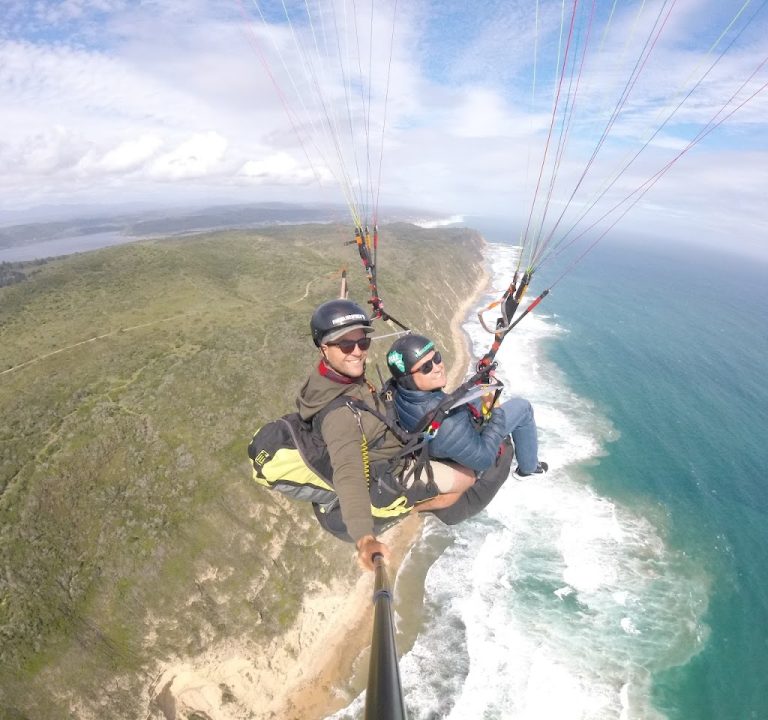
Paraglide Africa – Wilderness is a Sports school establishment in Wilderness, Western Cape, South Africa
Wilderness
Western Cape
6538
South Africa
Curriculum
Paraglide Africa’s Wilderness programme is structured to support learners from complete beginners through to more advanced paragliding proficiency, with a clear progression pathway anchored in practical skill development and theory. The organisation emphasises a blended approach where theoretical understanding is developed online before arriving at the training site, followed by hands‑on instruction in real flying environments along the Garden Route, centred on Wilderness and the neighbouring Sedgefield area.
The curriculum recognises distinct levels of study. The introductory offering is described as a Beginner Paragliding Course, designed for newcomers with no prior experience. This entry point focuses on grounding learners in canopy control, equipment use, ground handling, and the fundamentals of launch and landing techniques. The structure allows participants to move toward more autonomous flying as confidence and competence grow, subject to meeting practical requirements.
Beyond the beginner stage, the programme webpage notes a pathway into intermediate to advanced training, indicating a multi‑tiered learning trajectory. While exact course lists and durations are not enumerated in the available materials, the progression is framed as a continuum from initial air‑craft familiarisation to higher levels of flight ability and safety awareness.
Areas of study within the curriculum are presented as both practical and theoretical. The practical component includes ground handling and canopy control, equipment setup and use, and core flight manoeuvres. As learners advance, the curriculum introduces launch and landing techniques, ridge soaring, site awareness, and basic thermal understanding. Flight planning basics and decision‑making in the air are emphasised to cultivate safe, informed flying choices.
Theoretical learning is integrated through an online theory platform prior to arrival and continual assessment during the course. The use of a blended online‑and‑on‑site model is highlighted as a means to reinforce safety, risk management, and general aeronautical knowledge, enabling trainees to pursue licencing through SACAA/SAHPA and, if chosen, to convert or obtain international credentials for use abroad.
Distinctive learning resources include a dedicated online theory component that precedes on‑site instruction, enabling learners to enter practical sessions with foundational knowledge. The programme also emphasises a tailored, instructor‑led experience with small groups, which supports personalised feedback, ensures adequate airtime, and accelerates skill acquisition within a controlled learning environment.
Short courses and professional training are encapsulated within the Basic Paragliding Training framework, which combines practical flight exposure with online theory to prepare participants for supervised and eventually unsupervised flight after licensing. The emphasis remains on safety, gradual skill development, and a clear route toward recognised certification.
In terms of delivery formats, the curriculum leverages on‑site training locations along the Garden Route, offering real‑world flying conditions that reinforce the theoretical components. While the primary focus is on in‑person instruction, the online theory element provides flexibility and a structured preparation pathway that complements hands‑on sessions.
Support structures and additional learning opportunities are implied through small training groups, ongoing instructor guidance, and the potential for licensing support after course completion. The programme positioning suggests a commitment to safe practice, continuity of learning, and alignment with national licensing frameworks, along with the possibility of pursuing international licence arrangements where appropriate.
For prospective learners considering the Wilderness programme, information indicates a coherent curriculum designed to foster gradual progression from ground handling and basic flight techniques to more advanced operations and decision‑making in the air. Further details regarding exact modules, elective short courses, or formal accreditation are not specified in the accessible materials, but the framework emphasises practical experience, online theory, and a structured pathway to licencing and continued flying opportunities. More information can be found by exploring the training pages and related sections of the Paraglide Africa website.
Website note: The body of materials emphasises Wilderness as a principal training site within the Garden Route, reflecting the programme’s commitment to a real‑world learning environment that complements online theory and instructor‑led practice. Learners seeking additional context or updates are encouraged to consult the main training pages for the latest guidance on course availability and progression options.
Learn more about the Beginner Paragliding Course and progression options
Faculties and Branches
Paraglide Africa operates as a specialised adventure education organisation delivering a range of paragliding experiences and instructional programmes. While the site presents activities rather than conventional university-style faculties, the structure can be understood in terms of distinct programmes, instructional tracks and geographic bases that support student services and practical training.
The core offering is the Beginner Paragliding Training course, described as an immersive, hands-on programme designed for newcomers. This training path combines online theory with extensive practical instruction, focusing on ground handling, canopy control, launch and landing techniques, and progressively more advanced flight activities under close supervision. The programme is promoted as the entry point for those seeking to obtain relevant licensing, with pathways to national (SAHPA/SACAA) and international credentials upon successful completion.
Beyond beginner training, the site references intermediate and advanced training options, indicating a layered instructional continuum aligned with pilot development. While detailed curricula for higher levels are not exhaustively itemised on the public pages, the offering clearly includes progression through escalating levels of skill, safety considerations, and decision-making in the air, consistent with a structured learning framework rather than ad hoc instruction.
In addition to formal training, Paraglide Africa emphasises experiential learning through guided tours and adventure flights. These activities operate as student services or experiential components that complement formal study, allowing participants to apply techniques in real-world settings while fostering situational awareness and mountain or coastal flying skills. Gift vouchers and bespoke flying experiences are also highlighted as external services that augment the student journey and attract a broader audience.
The organisation’s external partnerships and product affiliations are described as equipment distribution and expert gear advice. This element functions as a support service for students and enthusiasts alike, ensuring access to suitable equipment and informed purchasing decisions as part of the broader educational experience.
Geographically, the Wilderness and Garden Route region features prominently as the principal training environment. Wilderness is characterised as the main training site along the Garden Route, situated between George and Knysna, with travel and access details noted to assist prospective students. The landscape context—coastal, forested and lagoon-rich—positions the campus as a practical classroom for both ground-based theory and on-slope or in-flight practice. While other town or campus locations are not enumerated as separate faculties or campuses, the described sites imply a network of training sites within the Garden Route area, including Wilderness and nearby Sedgefield, which support differing flying sites and local conditions.
For prospective students and collaborators seeking further organisation, programme pages and training sections provide navigational pathways to more detailed information on courses, tours, and equipment guidance. Potential learners are encouraged to explore the main training hub and associated pages to understand the sequence of learning, licensing routes, and how practical sessions intersect with theory to deliver a coherent educational experience.
- Programmes: Beginner Paragliding Training; Intermediate–Advanced Training; conservation and eco-project activities.
- Student services: online theory components; practical ground handling; equipment advice; guided tours and experiences;
- Geographic bases: Wilderness and the Garden Route region, with sites along the coast and hills suitable for paragliding practice.
More detailed information can be found through the site’s training and products sections, which outline the relationship between courses, licensing pathways, and the practical opportunities available to learners and visitors alike.
Registration Details
Paraglide Africa – Wilderness offers a structured entry point for aspiring paragliders through its Beginner Paragliding Training programme. The courses are designed for complete newcomers, with instruction that progresses from ground handling and canopy control to low flights and full soaring flights, all overseen by experienced instructors. The programme emphasises small group sizes to ensure individual attention, ample airtime, and a solid foundation for safe, confident flying.
The Wilderness site forms the core of the training experience, situated along the Garden Route in the Western Cape. The venue is described as a scenic coastal town, well placed for access to ridge launches and the surrounding airspace. Practical training is complemented by an online theory component, enabling students to prepare ahead of on-site sessions and consolidate knowledge throughout the course.
Registration and participation are typically aligned with the Beginner Paragliding Training offering. Prospective students can find the relevant course information and apply through the standard Paraglide Africa pages dedicated to learn-to-fly programmes. While exact registration steps are not itemised in the public content, the primary entry point for beginners is the dedicated course page, which directs interested individuals to the applicable training package and scheduling details.
Course durations are presented as a combination of practical days and online theory, with the instruction period structured to optimise learning and progression. In the published materials, Wilderness is described as the primary training location, with the Garden Route setting providing the backdrop for hands-on sessions and site-specific safety considerations. The programme notes a focus on safety, equipment handling, launch and landing techniques, ridge soaring, site awareness, and basic thermalling as core learning outcomes.
- Where to apply: the Beginner Paragliding Training pages on Paraglide Africa’s site (linked from the main training sections).
- Typical content: online theory prior to arrival, ground handling, canopy control, equipment setup, launch and landing technique, flight planning, airspace safety, and decision-making in flight.
- Location: Wilderness, Western Cape, South Africa (Garden Route).
- Duration and structure: a practical training period complemented by online theory; training groups remain small to maximise coaching and airtime.
Potential applicants should review the specific course page for any dates, durations, or package options that are publicly listed. When ready to proceed, the site’s training and product pages provide the path to securing a place in the Beginner Paragliding Training programme. The content indicates that after successful completion of the course outcomes, participants may apply for the South African paragliding licence (through SACAA/SAHPA) and may obtain an international licence card or convert it to a local licence, depending on individual circumstances.
For further information and to initiate registration, interested parties are advised to consult Paraglide Africa’s training pages and related course materials. Visitors can access the primary course information through the site’s Learn to Paraglide sections and related training resources, with links visible on the main navigation for ease of discovery. Social media channels and the Garden Route contact option are also referenced for additional guidance and queries.
Sorry, no records were found. Please adjust your search criteria and try again.
Sorry, unable to load the Maps API.
Education and Educational Resources in Wilderness, Western Cape
Wilderness sits in a coastal region of the Western Cape where learners and families can access a range of educational opportunities across different phases of schooling and training. The area typically supports primary and secondary education through local government schools, as well as nearby private institutions that offer broader curricula or specialised streams. For those pursuing further study, the region forms part of a wider network that includes further education and training centres, with programmes designed to bridge school completion and tertiary study.
In terms of types of institutions, families commonly encounter:
- Public and independent schools delivering national curricula aligned through the South African school system, including foundational subjects and elective options that reflect local needs and interests.
- Further education and training (FET) colleges and private training centres offering practical qualifications, craft courses, and introductory diplomas relevant to regional industries.
- Higher education institutions in the broader Western Cape area, including universities, which may offer undergraduate degrees, honours programmes, and postgraduate study accessible through varying admission routes.
- Community and language learning centres providing early literacy initiatives, adult education, and foundational courses to support lifelong learning.
Common programmes and levels typically available include a mix of school-leaving certificates, vocational and technical qualifications, and entry-level higher education options. Learners progressing from school often encounter pathways such as national senior certificate programmes, recognised diplomas, and certificate courses designed to prepare for police, maritime, tourism, hospitality, and environmental sectors that are prominent in coastal regions. Local colleges frequently tailor programmes to seasonal industries and family-enterprise needs, enabling flexible study options alongside work commitments.
Learning support and student services form an important strand of the educational landscape. Schools and training centres commonly provide assistance with study skills, language support, and pastoral services aimed at promoting well-being and resilience. Tutoring, peer mentoring, and access to counsellors or career guidance are frequently available to help learners navigate course choices, examinations, and progression onto further study or employment.
Facilities and resources commonly found in Wilderness and the surrounding area include well-equipped libraries with lending collections and quiet study spaces, science and computer laboratories in larger institutions, and learning commons that encourage collaborative work. Sports facilities, outdoor recreation spaces, and arts venues are often integrated into campus layouts or nearby community hubs, supporting a holistic approach to education. Accommodation may be available for students arriving from other towns, with options ranging from campus-style residences to homestay arrangements facilitated through local networks.
Typical admission and registration pathways generally involve completing an application or enrolment form within the relevant institution or programme window, presenting required documentation, and meeting minimum academic or course-level prerequisites. Some programmes may have rolling admissions, while others align to annual cohorts. Information materials and guidance are commonly offered through schools, colleges, libraries, or official education portals, helping prospective learners understand timelines, eligibility, and available support services.
Beyond formal study, Wilderness benefits from community partnerships that connect learners with practical training, workshops, and cultural programmes. Local libraries, community centres, and environmental organisations often collaborate with educational providers to offer project-based learning, language programmes, and environmental stewardship activities. These experiences can enrich traditional study tracks and provide meaningful ways for families to engage with learning outside the classroom.