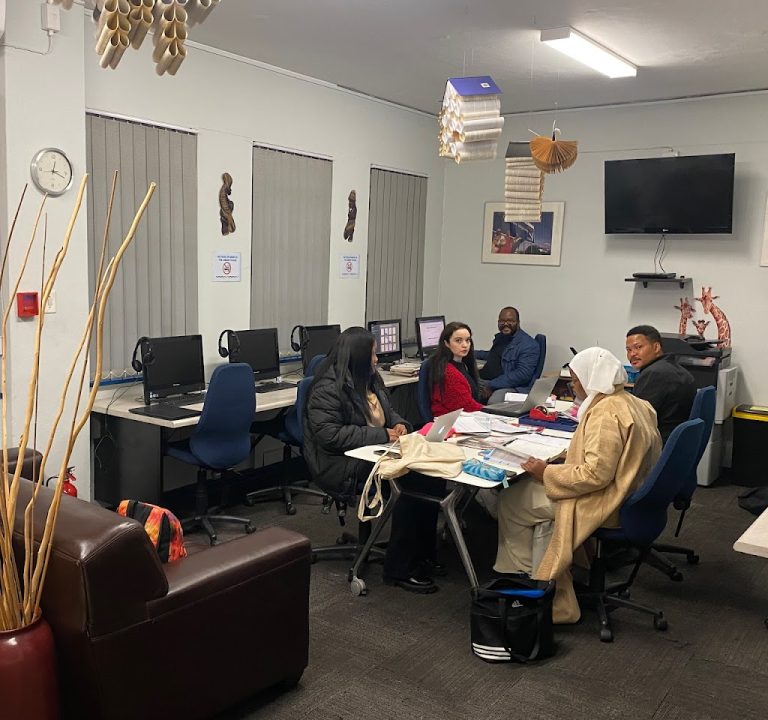

International House Johannesburg (The Language Lab) is a Language school establishment in Johannesburg, Gauteng, South Africa
Johannesburg
Gauteng
2193
South Africa
Curriculum
International House Johannesburg (The Language Lab) offers a structured and varied curriculum designed to meet diverse aims, from general English development to specialised professional training. The centre provides a broad spectrum of programmes and levels, allowing students to progress through foundational language skills to more advanced, academic or workplace-focused competencies. The curriculum is delivered by highly qualified teachers who emphasise practical communication, accuracy, and study skills within a culturally diverse learning environment.
General English courses form the core of the student experience. All General English programmes are delivered as four-week blocks, with four hours of morning instruction and optional additional sessions in the afternoon. The standard General English course combines integrated practice across listening, speaking, reading, and writing, and students may add Skills sessions (focusing on particular language areas such as pronunciation, grammar, or fluency) and Self-Access study. The Self-Access provision includes access to a library, computer room resources, and supervised study options, enabling learners to tailor their practice to personal goals. A key feature is the ongoing assessment framework, with end-of-month evaluations determining progression or retention to the same level, accompanied by a formal certificate marking the final level achieved.
The curriculum also accommodates a blended and online dimension. Acknowledging modern learning needs, a range of online self-study courses are available, spanning levels from Beginner (A1) to Proficiency (C2), and including specialist options such as Medical English for Health Professionals and English for Work. Online courses vary in format—from self-guided modules to tutor-assisted sessions—providing flexible options for learners who require remote access or additional practice outside the classroom. The online offering includes practical examples and sample materials, with pathways to arrange tutorled support when needed.
Short courses and professional training form a prominent element of the curriculum. The Professional English Improvement course is a part-time programme conducted over six Saturday mornings, and is designed for South Africans who use English as an additional language. This 24-hour course covers both general and business English, with a flexible topic selection that can include social English, business correspondence, meetings language, job interviews, presentations, grammar, and pronunciation. This structure supports practical communication needs in workplace settings and daily life, with a certificate issued on successful completion.
Distinctive aviation-focused provision positions IH Johannesburg as a centre of language proficiency within aviation contexts. The Aviation English programme centres on language proficiency and safety in aviation, including a formal Aviation English Language Proficiency test. The provision outlines six ICAO criteria—pronunciation, structure, vocabulary, fluency, comprehension, and interactions—and specifies a six-level framework for proficiency, with the minimum level required for licences. The campus functions as a recognised Test Centre and is affiliated with aviation authorities, offering preparation aligned with real-world aviation exchanges, role plays, and listening to authentic radio interactions. This specialist track demonstrates the centre’s capacity to adapt its curriculum to highly professional environments while maintaining rigorous language standards.
Teaching qualifications and teacher education are integrated into the curriculum through the CELTA and DELTA pathways. The CELTA course is a full-time, four-week qualification aimed at new entrants to teaching English as a foreign language, delivered within IH Johannesburg’s Cambridge-affiliated framework. The DELTA, a more advanced programme, offers a flexible modular pathway suitable for experienced teachers seeking professional development. Both courses emphasise practical teaching practice, observation, and written assignments, underscoring the centre’s commitment to high-quality pedagogy and continuous professional development.
In terms of delivery modes, a student-centred approach is complemented by opportunities for One-to-One classes. These private sessions are tailored to individual needs and have supported topics ranging from report writing and pronunciation to Cambridge exam preparation and general or business English. The flexibility of scheduling and customised content supports accelerated progression, targeted skill development, and greater confidence in real-world use of English.
Extracurricular support and resources further enrich the curriculum. A Self-Access Centre is introduced during the first week, with ongoing assistance from teachers, librarians, and computer room staff to guide independent study. A range of student clubs, such as debate activities during Self-Access time, promotes practical language use outside the formal timetable and fosters interaction among an internationally diverse student body. The combination of structured courses, self-directed study, and supportive learning resources helps learners build competence across reading, writing, listening, and speaking, while also developing metacognitive strategies for ongoing language improvement.
Overall, the curriculum at International House Johannesburg blends standard General English with specialised tracks, short courses, and professional development programmes. The integration of online and offline learning, extensive self-study facilities, and dedicated teacher training pathways reflects a holistic approach designed to deliver real-world language proficiency, informed by Cambridge standards and IH World Organisation practices. Details such as course dates, durations, or entry requirements are subject to change and prospective learners are advised to consult the official site for the most up-to-date information and to explore specific course pages for exact timelines and availability.
- General English: four-week blocks, morning instruction, optional Skills and Self-Access
- Online courses: self-study from A1 to C2 with specialist options
- Professional English Improvement: six Saturdays, 24 hours total
- Aviation English: ICAO-aligned proficiency test and specialised tuition
- CELTA/DELTA: Cambridge-certified teacher training with practical teaching practice
- One-to-One: tailored private lessons available in-person or online
- Support and resources: Self-Access Centre, library, computer room, Debate Club
Faculties and Branches
International House Johannesburg (The Language Lab) operates as a language teaching and teacher‑development centre situated in Johannesburg, Gauteng. As an affiliate of the International House World Organisation, the institution combines practical English language programmes with a dedicated teacher training department. The structure reflects a dual focus on language teaching for learners and professional development for educators, aligned with IHWO standards observed across a global network of IH schools.
The organisation’s academic framework centres on two primary domains: English language programmes for broad learner cohorts and specialist teacher‑training offerings. The English language provision spans General English, exam‑focused study, and customised courses designed to support academic progression or professional needs. A complementary self‑study and online pathway broadens access to learners who prefer flexible learning formats. This integrated approach ensures that programme delivery supports progression from entry levels through to advanced language mastery, with ongoing assessment and progression tracking.
Within the teacher training domain, the centre hosts and delivers Cambridge‑affiliated certificates and diplomas through its dedicated Teacher Training Department. Notably, CELTA (Cambridge Certificate in English Language Teaching to Adults) is offered in both in‑person and online formats, while DELTA (Cambridge Diploma in Teaching English to Speakers of Other Languages) provides more advanced, modular professional development for teachers with experience. These programmes reflect IH Johannesburg’s role within the IH World Organisation as a centre committed to high professional standards in language education and teacher training.
Specific programmes and services linked to these faculties include:
- General English and Exam‑Preparation courses for various proficiency levels, with options for short intensive study or longer‑term progression. Courses include integrated skills work, optional specialised modules, and self‑access study facilities on site, alongside online self‑study tracks.
- One‑to‑one bespoke tuition, available in person or via virtual formats, enabling targeted focus on individual learner goals such as pronunciation, academic language, business English, or examination preparation.
- Online Courses and Self‑Study offerings, including access to a range of subject‑specific curricula (e.g., English for Work, Medical English, IELTS preparation) with additional tutor‑assisted options.
- Aviation English programmes and a recognised Aviation English Language Proficiency testing service, reflecting an applied language focus tailored to aviation professionals and regulatory standards.
- CELTA courses, conducted at the Parktown premises or online, emphasising practical teaching practice, observation, and assessment aligned with Cambridge requirements.
- DELTA programmes, designed for experienced teachers seeking advanced theory and practice to inform ongoing professional growth.
Campuses and centres operate principally through the Parktown premises for in‑person delivery, with a broader online infrastructure that supports distance learning and flexible study. The Aviation English testing and training activities are integrated into the institution’s offerings, reinforcing its profile as a centre that combines language instruction with professional credentialing and accreditation.
As a member of IHWO, International House Johannesburg situates its faculties and branches within a global network renowned for language learning excellence. Prospective students and teachers can access information about courses, dates, delivery modes, and entry requirements via the official website, with further reference to IHWO‑related standards and their worldwide implementation.
For further details on individual courses, dates, and delivery formats, interested readers are encouraged to visit the official site at International House Johannesburg.
Registration Details
International House Johannesburg (The Language Lab) presents a structured pathway for learners and teachers seeking English language study, examination preparation, teacher training, and professional expansion. The registration process is organised by programme, with information presented on the institution’s dedicated pages. Prospective students and professionals are encouraged to review the relevant section to understand how to apply, what is required, and the available modes of study.
Overview of the application process
General English and online courses are described with course lengths, daily structures, and options such as Standard General English, Skills, and Self-Access components. Admissions for each programme are coordinated via its specific page, which provides details about start dates, course content, and progression. Prospective applicants should identify the programme of interest—whether General English, Online Courses, Aviation English, or Professional English Improvement—and follow the guidance on the corresponding page to initiate enrolment. Where a direct application form or submission process is noted, the page will outline the steps to proceed and any prerequisites.
Where to apply or obtain application information
- General information and online courses: General English and Online Courses.
- Aviation English and related testing services: Aviation English.
- Teacher training courses including CELTA and DELTA: CELTA and DELTA.
- For contact and payment information associated with specific courses, see the relevant programme pages, and consult the link How to Pay for fee-related guidance.
Eligibility and entry requirements (as stated)
On the CELTA page, the applicant profile outlines that candidates should have an awareness of language and a competence in English to follow the course and teach. The DELTA page notes that DELTA is intended for teachers with at least one year’s experience. For Aviation English, the proficiency framework outlines a minimum standard (Level 4) required in order to obtain a certificate, though the page focuses on assessment criteria rather than entry prerequisites. General English courses specify that learners are placed into appropriate levels after assessment, with progression contingent on ongoing assessment and end-of-period results.
Documents or materials typically required
Course pages set expectations for documentation and preparation, such as the CELTA pre-course tasks and the need to bring appropriate identification on the start date, as described in the CELTA section. In the case of the Professional English Improvement course, the course details emphasise payment and deposit requirements, and a photo ID is requested on the first day of registration. The Aviation English page describes testing procedures and the framework used for assessment, with preparatory guidance for prior study and proficiency requirements. Where specific document lists are provided (for example, for CELTA or other courses), those pages are the primary reference for required materials.
Contact and support channels
Details for course-specific enquiries and application processes are provided within each programme page. For instance, CELTA applicants are guided to contact the CELTA team via the CELTA page, while aviation and general English learners are advised to engage with the corresponding sections for registration guidance. The site also directs users to relevant information about payments and course prerequisites through linked pages such as How to Pay and the online course sections. Where direct contact details are given (such as email or phone numbers on individual pages), potential applicants are encouraged to use the listed channels on those pages to obtain the application form, submission instructions, and any required documentation.
Overall, registration at International House Johannesburg (The Language Lab) is a programme-directed process with clear pathways on the site. Prospective students and professionals should consult the individual programme pages for General English, Online Courses, Aviation English, CELTA, and DELTA to access the latest application instructions, prerequisites, and documentation requirements, and to locate the appropriate contact and payment references.
Sorry, no records were found. Please adjust your search criteria and try again.
Sorry, unable to load the Maps API.
Education and Educational Resources in Johannesburg, Gauteng
Johannesburg, situated in Gauteng, offers a diverse range of educational opportunities across public, private and higher education sectors. As a major urban hub, the city hosts a broad spectrum of institutions designed to support learners at different life stages, from early schooling to advanced postgraduate study. The educational landscape combines traditional campuses with contemporary learning facilities, reflecting the city’s emphasis on accessibility and skills development.
Within Johannesburg, learners can encounter a variety of institution types. Public and independent primary and secondary schools provide formal schooling aligned with national curricula and assessment frameworks. Further education and training colleges deliver vocational and professional programmes aimed at equipping learners with practical skills for the workplace. Tertiary education is represented by universities and specialised institutes offering undergraduate, postgraduate and professional qualifications. Alongside traditional campuses, numerous private colleges and community-based training centres provide access to certificates, diplomas and short courses across a range of disciplines.
Typical programmes and levels reflect broader regional and national patterns. Students may pursue matriculation or equivalent senior secondary qualifications, alongside diploma and degree programmes at bachelor’s level. Postgraduate studies, professional qualifications and short courses are available across disciplines such as science, engineering, health, business, arts and information technology. Vocational and technical pathways are well represented through programmes that emphasise applied learning, practical competencies and industry relevance.
Learning support and student services are commonly available to assist learners across institutions. These may include learner advisory services, academic tutoring, language and literacy support, and career guidance. Support for students with disabilities, mental health resources and accessibility services is increasingly prioritised to promote inclusive education. Admissions processes typically involve a combination of school results, entrance assessments, and, where applicable, interviews or portfolio reviews. Open days, application windows and registrar offices commonly provide guidance on requirements, timelines and budgeting considerations.
Facilities and resources play a central role in the learning environment. Libraries with study collections and quiet workspaces form a core part of campus life, supplemented by computer laboratories and digital learning portals. Laboratories for science, engineering and technology programmes support practical experimentation and project-based learning. Sports facilities, gymnasia, courts and fields enable active lifestyles and team participation, while arts and performance spaces foster creativity. Accommodation options, including on-campus residences and approved off-campus housing, are often available for students relocating to the city.
Typical pathways for learners in Johannesburg involve a progression from secondary schooling to higher or further education, with clear routes depending on the chosen field of study. Students may plan to complete a national senior certificate or equivalent, apply for diploma or degree programmes, and consider postgraduate studies after obtaining an undergraduate qualification. Vocational training and professional development courses provide alternative or complementary routes, offering skills aligned with local industries and employment opportunities. Assistance and guidance from admissions offices, career centres and online portals help prospective learners compare courses, assess entry requirements and understand funding options where available.
Website resources and official portals commonly provide information on programmes, campus facilities and student support. While institutional details vary, the shared aim across Johannesburg’s educational landscape is to enable accessible, quality learning and to connect learners with pathways that align with personal goals and local opportunities. For families evaluating options, visiting campuses, reviewing course outlines and consulting with guidance professionals can support well-informed decisions about when and how to engage with higher or further education in the city.
- Typical programmes include matriculation routes, diplomas, undergraduate degrees, postgraduate studies, professional qualifications and technical or vocational certificates.
- Common facilities encompass libraries, computer labs, science and engineering laboratories, sports facilities and student accommodation where available.
- Admissions commonly involve academic results, placement tests or interviews, with open days and registrar guidance to aid planning and budgeting.
References to institutions, fees and exact entry requirements are intentionally general to reflect a broad spectrum of options across Johannesburg and Gauteng. Interested learners are encouraged to explore official university and college websites for precise information and to consider regional study opportunities that align with personal educational aims.