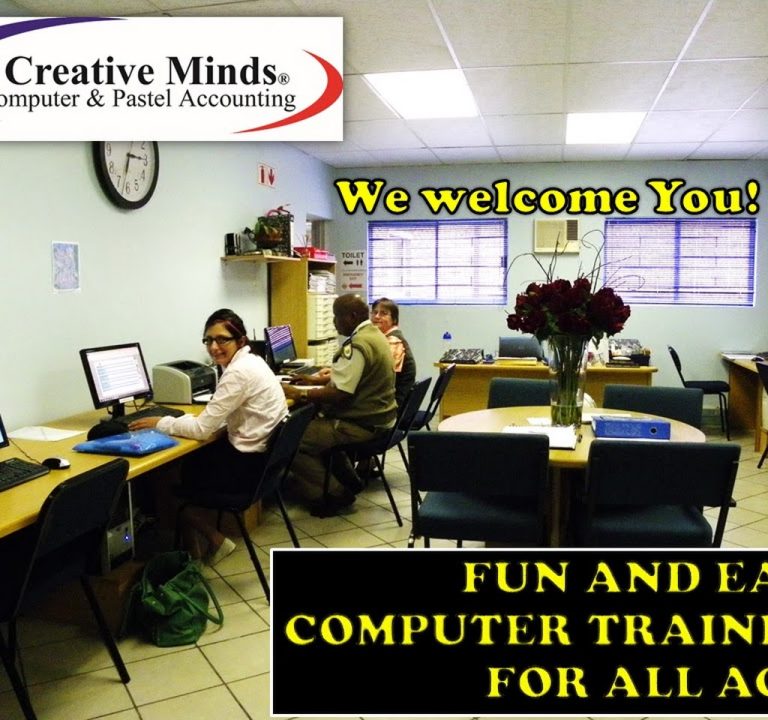

Creative Minds Nelspruit is a Computer training schools establishment in Mbombela, Mpumalanga, South Africa
Mbombela
Mpumalanga
1201
South Africa
Curriculum
Creative Minds Nelspruit, located in Mbombela, Mpumalanga, aligns its curriculum with the organisation’s broader commitment to accessible, practical computer education. The centre forms part of a nationwide network of more than fifteen training facilities that emphasise flexible delivery to suit diverse learning needs. The curriculum is designed to accommodate learners who are new to computing as well as those seeking to advance their existing skills, with pathways that support progression from beginner to more advanced levels.
The programme offering spans a range of core computer competencies and practical ICT applications. The emphasis is on building confidence with essential digital tools, ensuring learners acquire practical, transferable skills that are directly applicable in workplace and everyday scenarios. Instruction is tailored to accommodate different entry points, from self-paced online modules to instructor-led sessions, enabling students to choose the format that best fits their schedule and learning style.
Within the curriculum framework, learners can engage with short courses and professional training that cover foundational topics such as basic computer literacy, spreadsheet and word-processing proficiency, and essential digital organisation. The centre also supports more targeted or practical training through bundles and specialist modules, which are commonly offered across the wider network. While specific course titles and detailed outlines are not enumerated at the local level, the programme structure is positioned to provide structured, outcomes-based learning that can be customised to organisational needs or individual goals.
A notable feature of the curriculum approach is the blend of in-centre and online delivery. Creative Minds Nelspruit participates in the broader model that includes online computer training and one-on-one instruction, allowing learners to progress at their own pace or receive guided support as required. The availability of online options is particularly valuable for those balancing work, family commitments, or transport considerations, ensuring learning remains accessible across varying circumstances.
Hands-on practice is emphasised through practical exercises aligned with real-world tasks. The learning experience at Creative Minds Nelspruit benefits from guidance that mirrors professional settings, with opportunities for individual attention in one-on-one sessions as well as collaborative exercises in small groups. The centre also supports learners who prefer on-site group training at their organisation, reflecting the broader network’s capacity to deliver customised programmes to meet corporate requirements.
In addition to core instructional content, the curriculum is complemented by resources designed to enhance digital fluency and problem-solving abilities. Learners can access materials and references through the centre’s digital platforms, with a focus on ensuring information is current and relevant to contemporary workplace technology. The blended learning approach combines the flexibility of online modules with the personalised coaching that characterises face-to-face instruction, supporting a well-rounded skill development trajectory.
Extracurricular and support elements form an integral part of the learner experience. Although specific clubs or societies are not detailed, the emphasis on one-on-one and customised group sessions indicates a supportive learning environment where trainers can address individual challenges, track progress, and adapt guidance accordingly. The centre’s commitment to accessibility—highlighted by the statement that computers are not required when learning at a physical centre—underscores a student-centred approach that prioritises ease of access and reduces barriers to participation.
Distinctive learning resources associated with the wider Minds network include a cadre of professional training offerings and course bundles that package essential competencies into coherent learning journeys. Although local scoping details may vary, the curriculum at Creative Minds Nelspruit is designed to harmonise with these broader resources, ensuring learners can leverage well-established materials and proven instructional methods while pursuing personalised educational objectives. For prospective students seeking further information about available courses, delivery options, and the prospectus of computer courses, the provider’s central website offers a gateway to additional details and registration pathways.
Further information about the curriculum and delivery options can be explored through the organisation’s official site, which outlines corporate in-house training, flexible face-to-face programmes, and the range of online and on-site learning opportunities available across facilities nationwide. This framework supports continued professional development for individuals and organisations seeking practical ICT skills that translate into workplace competence and confidence.
For more information on programmes, locations, and delivery formats, visit the Minds resource hub at Mind’s Computer Training.
Faculties and Branches
Creative Minds Nelspruit, situated in Mbombela, Mpumalanga, forms part of a wider network of computer training provisions described on the organisation’s national platform. From an external viewpoint, the structure emphasises decentralised access through multiple training facilities spread across the country, offering a broad footprint that supports learners in and around South Africa’s urban and peri-urban centres. While specific campus names in Mpumalanga are not itemised on the public pages, the arrangement is presented as a cohesive system where programmes and services are harmonised across centres to ensure consistency of delivery and quality of learning.
The organisation presents itself as hosting a suite of learning opportunities under a unified brand, with a focus on practical, hands-on computer training. The delivery model spans one-on-one sessions, on-site group training for organisations, and online courses, reflecting a flexible approach designed to accommodate different learner needs and corporate requirements. This multi-channel structure is described as operating across more than 15 facilities nationwide, which implies that Creative Minds Nelspruit benefits from access to shared resources, standardised curricula, and centralised support services while maintaining a local presence for students and organisations in the region.
In terms of faculties or departments, the public-facing information centres on computer training rather than a conventional collegiate faculties framework. Courses are categorised into broad clusters such as basic courses, advanced topics, and course bundles, with specific modules like Excel, Windows, Microsoft packages, Outlook, and other core digital skills indicated within the programme catalogue. Although the site does not list a formal hierarchy of faculties or schools in the traditional sense, the arrangement aligns a spectrum of cognitive and practical competencies under a cohesive offering that can be customised to individual learners or corporate teams. This structure suggests a focus on programme strands that map to user needs, ranging from beginner to more advanced proficiency levels.
Regarding student services and programme relevance, the material emphasises flexible learning pathways and accessibility. The claim that “no computers are required when learning at one of our centres” highlights a learner-friendly environment, potentially supported by on-site facilities that enable practical demonstrations and hands-on practice. The inclusion of both in-centre and remote learning options indicates a commitment to widening participation and accommodating diverse schedules, which is particularly relevant for working professionals and organisations seeking up-skilling without disrupting operations excessively.
The nationwide reach is complemented by corporate offerings, including in-house training for organisations and a focus on delivering tailored solutions. This suggests that the structure is designed to support a range of stakeholders—from individual learners seeking foundational digital literacy to businesses pursuing structured, result-oriented skills development. For Creative Minds Nelspruit, this implies alignment with regional needs while benefiting from the scale and oversight of a national network, enabling up-to-date course materials, standard assessment practices, and shared guidance on progression paths.
Further information about specific campus locations, available programmes, and entry requirements can be accessed via the organisation’s main portal, which provides additional detail on course bundles, individual modules, and the overall learning proposition. More about the breadth of services, delivery modes, and the networked centre model can be explored at the official website: Minds.
Overall, the structure presented positions Creative Minds Nelspruit within a wide, service-oriented framework of faculties and branches designed to deliver practical computer training across South Africa, with an emphasis on flexible learning, corporate partnerships, and nationwide consistency.
Registration Details
Overview of the registration process
Creative Minds Nelspruit (Mbombela, Mpumalanga) can be associated with Minds.co.za, a provider of computer training courses with more than 15 facilities nationwide. The available information indicates that prospective students can initiate contact to discuss course options and obtain further details about programmes, rather than presenting a fixed, published registration deadline or a rigid admission process. The emphasis is on obtaining guidance from staff to explore suitable courses and training formats.
In practice, interested individuals or organisations may request a quick call-back to discuss course prospects, obtain information about the prospectus of courses, and determine the most appropriate study path. This contact mechanism is facilitated through the site’s “Call Me Back” feature, which connects potential learners with staff who can outline next steps and available options.
Registration and enrolment appear to be flexible, accommodating different training modalities such as one-on-one sessions, online delivery, and group training for organisations. There is also the option to arrange training at one of the nation-wide training facilities or on-site at organisations, subject to availability and the chosen programme.
Where to apply or get information
To initiate the process, prospective learners should start by requesting more information and discussing course options through the available contact mechanism on the site. The following link provides access to the call-back service for immediate assistance: Call Me Back.
Further information about the provider’s offerings is surfaced through the main site, including pathways to specific courses and bundles. While there is no single, dedicated “registration” page visible in the supplied content, potential applicants may explore the company’s course pages to understand available programmes and training formats. See the broader site for details: Minds.co.za.
Eligibility, documents and entry requirements
The provided content does not specify a formal set of eligibility criteria, nor the exact documents required for enrolment. In line with this, the information remains general and focuses on availability of courses and contact channels. Where specific requirements are not stated, applicants are advised to consult directly with staff through the call-back service or centre representatives to obtain precise guidance tailored to the chosen course and delivery method.
Contact and support channels
Support is facilitated through the site’s contact options. Prospective learners can request a call-back to discuss programmes and gather the necessary information about registration and entry paths. Access the main contact route here: Call Me Back. Additional information about the provider and its privacy and terms can be found via the site’s legal and policy pages.
Note: The content provided primarily reflects Minds.co.za’s nationwide offering, with no site-stated deadlines, fees, or forms in the supplied material. Visitors are encouraged to reach out via the stated channels to obtain the most accurate and up-to-date registration guidance for Creative Minds Nelspruit and other locations.
Sorry, no records were found. Please adjust your search criteria and try again.
Sorry, unable to load the Maps API.
Education and Resources in Mbombela, Mpumalanga
Mbombela, the administrative centre of Mpumalanga, presents a diverse landscape of educational opportunities tailored to learners of different ages and aims. In the public education system, learners can expect a mix of primary, junior secondary and senior secondary schooling within accessible neighbourhoods, alongside specialised further education and training options that support vocational and technical routes.
Across Mbombela, families commonly encounter a range of institutions that cover traditional academic pathways and practical skills development. Schools typically offer curricula aligned with national standards, with programmes designed to support progression to further study or entry into the workforce. Vocational and technical training centres provide focused training in trades, information technology, business studies and health sciences, often with modular formats that accommodate learners balancing study with work or family commitments.
Higher education in and around Mbombela includes universities and registered campuses that broaden access to undergraduate and postgraduate studies. These institutions frequently emphasise applied research, professional preparation and partnerships with local industries. Prospective students may encounter a spectrum of study modes, including full-time, part-time and distance learning options, depending on the institution and programme chosen. General entry pathways commonly begin with a recognised senior certificate, supplemented by institution-specific requirements or placement assessments.
Training centres and private colleges also contribute to the educational fabric, offering programmes in business administration, creative arts, hospitality, engineering technology and health and wellness. These facilities typically provide career-focused certificates, diplomas and diplomas with articulation to higher levels, subject to meeting admission criteria and satisfactory progression through assessments.
Learning support and student services form a notable part of the Mbombela educational environment. Libraries and study spaces are commonly equipped with quiet zones, computer access and reference materials across multiple subjects. Guidance services may assist with career planning, programme selection, scholarships and accommodation information. Language support, tutoring, and extra help for learners with learning differences are often available through schools and post-school providers, aiming to promote inclusive access and successful completion of programmes.
Facilities and resources typically associated with Mbombela’s educational institutions include well-equipped laboratories for science and technology, computer suites, and dedicated practical spaces for trades learning. Indoor and outdoor sports facilities support a balanced development of physical education and competitive activities, while supervised campus housing and nearby accommodation options cater to students from outside the local area. Safety, transport links and affordable access to amenities are common considerations in campus planning and student life.
Typical pathways through Mbombela’s education system begin with formal enrolment periods at the start of the academic year, followed by orientation sessions and placement assessments where appropriate. Prospective students are encouraged to consult official admissions guidance published by individual institutions, which commonly outlines registration dates, required documentation, subject combinations, and any bridging or foundation modules. Once admitted, students may move through successive levels of study or transition into professional training, continuing education, or higher degrees depending on personal aspirations and academic performance.
For communities seeking information, regional education authorities and official portals provide entry points to school calendars, programme details and student services. Local authority sites hosted by Mpumalanga Province and national education departments offer overviews of available resources and general advice on how to plan a successful educational journey in Mbombela and its surroundings. Learners and families can expect a combination of traditional classrooms, practical training environments and supportive services designed to foster preparation for further study or skilled employment.
Further information can be explored through official regional outlets at https://www.mpumalanga.gov.za and national resources at https://www.gov.za, which outline the wider framework guiding education and training in South Africa.