
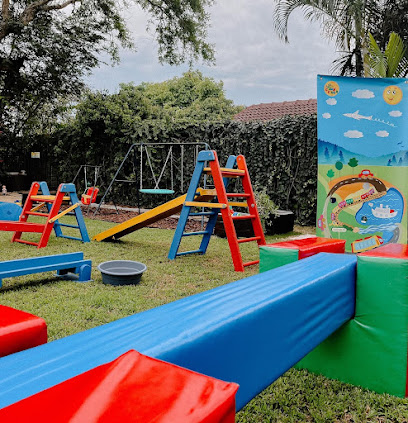
Clamber Club Toddlers – Nelspruit is a Education centers establishment in Mbombela, Mpumalanga, South Africa
Mbombela
Mpumalanga
1200
South Africa
Curriculum
Clamber Club Toddlers – Nelspruit follows a carefully crafted, play‑centred curriculum designed for children aged between 1 and 3 years. The programme emphasises development across multiple domains, supporting gradual progression from early exploration to growing familiarity with group learning in a nurturing setting. Each class is built around weekly themes and engaging activities that align with the needs of toddlers as they learn through movement, play, and guided discovery.
The Toddler pathway is divided into two age groups, ensuring age‑appropriate activities and a structured yet flexible pace. For ages 1–2, the Froggies classes focus on developing body coordination and balance through movement and a range of gross motor activities. For ages 2–3, the Leap Frog classes expand on those foundations by introducing a wider variety of concepts and activities that foster confidence, cognitive development, and social interaction. Across both groups, the curriculum integrates a blend of gross motor play, fine motor development, sensory experiences and early perceptual learning to support holistic growth.
Core areas of study include:
- Gross motor development, with activities designed to enhance balance, coordination and reliable body awareness
- Fine motor play, promoting hand–eye coordination through purposeful, age‑appropriate tasks
- Sensory experiences, including tactile, auditory and visual stimulation to foster curiosity and learning through the senses
- Creative play and music, using songs and rhythm to support language development and social interaction
- Perceptual and cognitive development, encouraging sequencing, timing, problem solving and early thinking skills
- Socialisation and early social‑emotional learning, creating opportunities for interaction with peers and caregivers in a supported group setting
The programme is designed to promote “learning through doing” and “learning through play”, recognising that play is a vital vehicle for development in the early years. Sessions offer a safe environment where toddlers can explore, imitate and experiment under the gentle supervision of a familiar caregiver, helping to ease the transition into a school‑like routine while preserving the joy of discovery.
Distinctive resources and components of the curriculum include a wide range of equipment and props specifically chosen to maintain engagement and to support progression in gross motor tasks, sequencing and rhythm. The use of Jog the Frog as a recognisable mascot and storytelling through movement creates a memorable framework for learning, while structured themes provide continuity across weeks and terms. These resources are designed to enhance active participation, encourage social bonding and reinforce concepts in a hands‑on manner.
In addition to regular weekly classes, Clamber Club Toddlers supports parents and caregivers as partners in learning. The format allows for one‑on‑one time with the child, enabling adults to connect with their little ones while participating in the activities. This approach not only strengthens bonding but also models positive behaviours and strategies that families can continue at home, contributing to consistent developmental experiences outside the class setting.
Short courses or professional training components are not detailed within the public information for Clamber Club Toddlers specifically in Nelspruit. The available information focuses on ongoing play‑based classes, structured around developmentally appropriate milestones rather than formal accreditation or entry requirements. For families seeking additional or extended resources, the broader Clamber Club framework offers playschool and other programmes, which share a common emphasis on sensory motor learning and early childhood development.
Looking ahead, the curriculum is designed to be adaptable within a small‑classes environment typical of Clamber Club offerings. By combining movement, music and guided sensory play, the programme aims to support early language development, social readiness for formal schooling and the development of life skills such as cooperation and problem solving. All activities are curated with a focus on safety, enjoyment and meaningful engagement to make every session a constructive step in a child’s learning journey.
Further information about Clamber Club’s toddler curriculum, specific class offerings, and location details in Nelspruit can be found through the official site. Families are encouraged to explore class discovery pages to locate the nearest Clamber Club Toddlers session and to learn how the play‑based approach aligns with their child’s developmental needs.
Faculties and Branches
Clamber Club Toddlers – Nelspruit, located in Mbombela, Mpumalanga, operates within a broader organisational framework that centres on a family of educational programmes designed to support early childhood development. While the precise on-site campus or branch details for Nelspruit are not delineated in the available content, the overarching structure is presented as a franchised model with multiple programmes under the Clamber Club banner.
The organisation describes a diverse portfolio of services and curricula that together form its educational ecosystem. Core offerings include Baby Classes, Toddler Classes, and Playschool, each aimed at different developmental stages and learning objectives. In addition to these early learning strands, Clamber Club also delivers Sports for Schools, and provides Party services, expanding the scope of engagement beyond the classroom. These programmes are presented as discrete “faculties” or content areas within the same brand family, each with a specialised focus yet aligned to a common philosophy of learning through play and movement.
From a governance and programme development perspective, the site highlights a head office and a team of franchise managers who oversee the brand’s expansion and operational consistency across locations. This structure supports the delivery of the various offerings through a network of franchisees, teachers, coaches and trainers who implement the programmes at their respective centres. The presence of a dedicated administration function is indicated, alongside marketing, strategy and product development roles, underscoring a model that combines central guidance with local delivery.
Regarding branches or campuses, the site uses city-specific examples in its “Find A Club” sections but does not explicitly list a Nelspruit or Mbombela site within the provided excerpts. In a broader sense, the organisation communicates that Clamber Club operates through franchised locations and partner centres, enabling families to access a spectrum of educational experiences—from structured playschool activities to movement-based toddler and baby classes and school-focused sports programmes. Where listed, each branch typically aligns with the local delivery of one or more programme strands, supported by the national brand framework and field management.
Programme integration is a key feature of the structure. Each faculty area is described as contributing to holistic development outcomes, such as gross and fine motor skills, perceptual development, language growth, socialisation, and life skills. The sports and party offerings further extend opportunities for physical literacy and social engagement, while Playschool emphasises sensory and perceptual learning within a nurturing environment. The model is designed to enable a child-friendly progression from early years through to more specialised experiences, with parental involvement and community ties fostered as part of the learning journey.
For readers seeking specifics about a Clamber Club Toddlers – Nelspruit location, it is advisable to consult the main Clamber Club website or direct local search tools to identify current branch details, enrolment options and class timetables. The brand’s strength lies in its clearly defined programme categories and the scalable franchise framework, which together support consistent delivery across diverse South African communities.
- Faculties and programme areas: Baby Classes, Toddler Classes, Playschool, Sports for Schools, Parties.
- Support and governance: Head Office, Franchise Managers, Administration, Marketing, Product Development.
- Branch model: Franchised locations delivering the listed programmes; specific Nelspruit details not stated in the provided content.
For more information on the full spectrum of Clamber Club offerings, visit the official site at clamberclub.com.
Registration Details
Clamber Club Toddlers – Nelspruit operates within Mbombela, Mpumalanga, South Africa, offering a dedicated programme for children aged 1 to 3 years. The registration process for Toddlers is designed to be straightforward, guiding prospective families through online enrolment or club location selection so that sessions can commence smoothly.
Overview of the registration pathway:
- Prospective parents or guardians are encouraged to locate the nearest Clamber Club Toddlers venue using the organisation’s general “Find your Nearest Clamber Club for Toddlers” resource. This helps identify available classes and the most convenient session for the child and caregiver.
- Once a suitable class is found, the enrolment or registration action is typically prompted via the club’s online pages. The site provides direct pathways such as “Join the Club!” or “Enrol Today!” that lead to the relevant registration or booking flow for Toddlers classes.
Where to apply (online):
- Find your Nearest Clamber Club for Toddlers: Join the Club
- Join the Club / Enrol Today options are shown on the platform to initiate the registration process for Toddlers classes. For playschool offerings, similar enrolment prompts are available via the Playschool page, which can be used as a reference point for the general registration approach across Clamber Club programmes.
Eligibility and entry considerations:
- The Toddlers programme caters to two age bands, with Froggies for ages 1–2 and Leap Frog for ages 2–3, reflecting the programme’s structure designed to align activities with developmental stages.
- Registration and class placement typically align with these age bands and the available weekly themes and activities advertised on the site. No specific deadlines or fees are stated in the available content, so the general guidance is to use the online Find a Club tool to determine current availability and suitability for the child’s age range.
Documentation and requirements:
- The site content does not specify particular forms, documents, or deadlines for registration. In line with the provided information, prospective families should rely on the online enrolment prompts and the club’s registration interface to complete the process. No additional paperwork is listed within the publicly available content provided.
Contact and support channels:
- The Clamber Club platform lists social channels and a general contact approach. While direct phone numbers or email addresses are not included in the content here, the website provides links to its social media pages and the main site where further assistance and registration support can be obtained. Families are encouraged to use the official website links to access Help or Enrolment pages if available.
Location context:
- Although the content explicitly references Clamber Club Toddlers in various regions, the registration approach described here applies to the Nelspruit location within Mbombela, Mpumalanga. Parents and guardians should use the site’s Find a Club resource to confirm class availability and register for the Toddlers programme in their local area.
In summary, registration for Clamber Club Toddlers – Nelspruit follows the online pathways highlighted by the organisation, emphasising age-appropriate class options (Froggies for 1–2 and Leap Frog for 2–3) and location-based class selection. Prospective families are advised to visit the provided links to identify the nearest class and initiate enrolment through the club’s standard online enrolment flow.
Sorry, no records were found. Please adjust your search criteria and try again.
Sorry, unable to load the Maps API.
Education and Resources in Mbombela, Mpumalanga
Mbombela, a bustling centre in Mpumalanga, presents a diverse landscape of educational opportunities for learners and families. From early schooling to higher education and specialised training, the area supports a broad range of pathways designed to suit different interests, abilities and futures. The size and variety of institutions reflect a commitment to accessible education within the region, complemented by a network of local services that assist learners throughout their studies.
In terms of formal schooling, the region hosts a mix of primary and secondary campuses aligned with national curricula. Schools are commonly equipped to address core subjects such as languages, mathematics, natural and social sciences, as well as arts and physical education. Across many institutions, learners can expect to encounter additional support services, including literacy and numeracy programmes, guidance and career counselling, as well as extracurricular activities that promote well‑rounded development. Schools frequently work in collaboration with district resources to enhance learning through targeted interventions and extended learning opportunities.
Post‑secondary options extend beyond traditional schools to include further education and training colleges and a range of colleges offering vocational and technical programmes. These institutions typically offer certificates, diplomas and national qualifications designed to equip students with practical skills for immediate employment or further study. Programmes commonly span information technology, engineering, healthcare support, business administration, hospitality, creative industries and construction, among others. Apprenticeships and work‑integrated learning are often available through partnerships with local businesses, industry bodies and training centres, enabling learners to gain hands‑on experience while completing their studies.
Higher education in the area is supported by public universities and university campuses with a presence in the wider Mpumalanga region. These institutions provide undergraduate and postgraduate degrees across faculties such as sciences, humanities, education and professional disciplines. While specific entry requirements and deadlines vary, general pathways typically involve registration through the central admissions framework, submission of necessary academic records, and, where applicable, provision of language proficiency or aptitude assessments. Prospective students are advised to explore foundation or access programmes that may bridge gaps and prepare entrants for degree study.
Learning support and student services are common features across Mbombela’s educational landscape. Libraries in schools and colleges offer study spaces, reference materials, and digital resources to support independent study and group work. Study skills workshops, tutoring services and literacy programmes are occasionally provided to assist learners who need extra help. Campus facilities frequently include computer labs, science and technical laboratories, and multi‑purpose spaces for lectures, seminars and group projects. Accommodation options, where available, may include on‑campus residences or local housing arranged to suit student life, with considerations given to safety and affordability.
Facilities and resources extend into the wider community. Recreational facilities, sports fields, gyms and cultural spaces contribute to a balanced educational experience, emphasising physical well‑being and creative development. Access to technology‑enabled learning, digital libraries and online databases is increasingly common, supporting remote study, research projects and self‑directed learning. Local support services, such as career guidance centres and disability services, help learners navigate admissions, course selection and accommodations as needed.
Typical pathways through Mbombela’s educational system involve a clear progression from primary education to secondary schooling, followed by choices between vocational training, college programmes or university study. Registration and admissions are generally handled through state or provincial portals, with guidance available through schools, institutions and official education sites. Prospective learners are encouraged to research study options, visit open days where possible, and consider foundation years or bridging courses if entry requirements present challenges. With a diverse mix of institutions and resources, Mbombela offers a supportive environment for pursuing varied educational ambitions within Mpumalanga and beyond.
For more information on regional education and resources, official portals provide updated guidance and programme listings. These resources help families and learners plan next steps, compare options and identify suitable routes aligned with individual goals.
Visit: South African Department of Basic Education and Mpumalanga Provincial Government for Centre‑level information and regional updates.