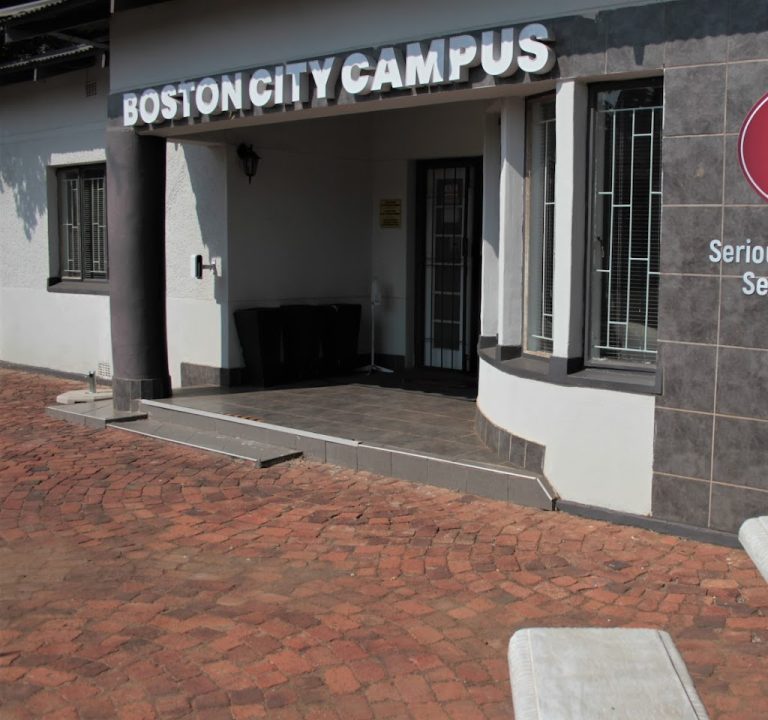

Boston City Campus – Potchefstroom is a Educational institutions establishment in Potchefstroom, North West, South Africa
Potchefstroom
North West
2552
South Africa
Curriculum
Boston City Campus – Potchefstroom presents a comprehensive range of educational offerings designed to support progression across different levels of study. The curriculum organisation mirrors the institution’s broader structure, with pathways in higher education (including degrees, diplomas, post‑graduate diplomas, advanced diplomas, higher certificates, and short courses) alongside focused short learning programmes aimed at immediate workplace skills and personal development. Across these offerings, the emphasis remains on practical relevance, nationally and internationally recognised qualifications, and the ability to go further in studies or employment.
Areas of study available to students in Potchefstroom span core business disciplines, information technologies, hospitality and tourism, creative media, legal and human resources, social sciences and health, as well as lifestyle subjects and digital learning. The curriculum is designed to reflect real‑world needs, with content structured to deliver applied knowledge, professional competencies and transferable skills. While specific modules and modules’ sequencing may vary by programme, the overarching aim is to equip learners with the tools required for both immediate workplace application and longer‑term academic credence.
Two distinct, but complementary, modes characterise the curriculum delivery. Higher Education programmes are presented within a framework that can include blended or distance‑based study, supported by Boston’s learner support infrastructure. This reflects the institution’s commitment to widening access while maintaining quality and throughput. The Short Learning Programmes (SLPs) and Personal Development options are designed for rapid upskilling and direct workplace applicability, with non‑credit bearing credentials that nonetheless recognise achievement and allow for potential access to further Boston qualifications through recognition of prior learning (RPL).
Distinctive learning resources are highlighted in Boston’s approach. Textbooks are included as part of many programmes, with further emphasis on digital learning tools and badges that recognise skills acquired throughout the learner journey. The institution also provides structured support through its Student Advisor services, Graduate+ resources and Graduate Support Services, ensuring assistance extends beyond course content to career guidance, study pathways and ongoing personal development.
For learners seeking flexibility, several programmes are designed for distance delivery with centrally located support. Learners can access study materials remotely while receiving assistance at designated Learner Support Centres. This model supports clear communication, timely feedback, and practical assessment arrangements that reflect the demands of modern higher education and professional practice.
Short courses and professional training form a notable feature of the curriculum, offering focused, employer‑relevant modules that cover administrative, financial, marketing, ICT, hospitality, health and wellness, and media practice disciplines. These short programmes typically emphasise hands‑on skills, end‑user software proficiency, customer service capabilities, and foundational business competencies, with the potential for progression to longer qualifications through recognised pathways.
- Examples of short courses commonly offered include administrative and reception duties, call centre operation, bookkeeper and payroll support, basic office administration, and essential ICT applications such as word processing, spreadsheets, and presentation software.
In addition to formal instruction, the curriculum recognises the importance of continuous support and employability outcomes. Learners benefit from access to guidance services, a focus on skill recognition through Digital Learning Badges, and resources designed to reinforce confidence and professional readiness. The combination of practical content, accessible delivery modes and structured learner support contributes to a curriculum that is responsive to evolving educational and employment landscapes in South Africa.
Faculties and Branches
Boston City Campus – Potchefstroom is presented as part of a national higher education network delivering a mix of higher education qualifications, short learning programmes and personal development options. The organisation is positioned as a registered and accredited provider offering qualifications that span degrees, diplomas, postgraduate diplomas, advanced diplomas, higher certificates and short courses. Within this structure, the institution emphasises both the breadth of its fields of study and the accessibility of learning through distance delivery supported by local learner centres.
Within the site’s overview of fields of study, several broad faculties or departmental areas are highlighted, each aligned with specific programmes and pathways. These include:
- Accounting & Financial Services
- Advertising, Communication & Public Relations
- Business Management & Leadership, Marketing, Administration & Service
- Hospitality, Events & Tourism
- Information Communications Technologies (ICT)
- Law & Human Resources
- Lifestyle & Digital Music
- Personal Development, Digital Learning Badges & Occasional Studies
- Social Science, Health & Sports
These fields of study indicate the structure of faculties or schools as presented on the Boston City Campus platform. The site aggregates related programmes under these headings, with links directing prospective learners to dedicated pages for each faculty or department. While precise institutional nomenclature for Potchefstroom is not separately enumerated in the supplied content, the listing demonstrates an organised, faculty-based approach to course delivery and student progression.
The site also signals the existence of various campuses, branches and learner support mechanisms that underpin programme delivery. The main portal communicates a nationwide footprint with Learner Support Centres that provide guidance and assistance to students engaging with distance learning. The material emphasises that learning is commonly conducted in distance mode, with local support infrastructure to assist learners wherever they study. This suggests that Potchefstroom learners may benefit from both remote access to Boston City Campus resources and a network of local support facilities as part of the national framework.
In addition to higher education offerings, the institution presents a range of short learning programmes designed to meet immediate workplace needs and personal development objectives. The short courses are organised by area of study, including Accounting, Advertising/PR, Business Programmes, Health/Sport/Wellness, HR/Legal Studies, Hospitality/Events/Tourism, Lifestyle/Digital Music, ICT Studies and Management/Marketing. This structure illustrates the breadth of faculty-aligned pathways accessible through the Potchefstroom campus network and its allied learning centres.
Programme progression is described as being supported by a combination of open-entry access and structured modules, with clear indications of the type of qualification (short learning programme versus higher education qualification). Prospective students can explore further through campus-wide resources and the site’s prospectus, which aggregates details about faculties, campuses, student support services and pathways. The overarching emphasis remains on high-quality education, recognised qualifications, and support systems designed to help learners progress within South Africa’s higher education landscape.
For more information about specific programmes, campuses or learner services, interested readers can visit the main site at the provided URL and navigate to the sections on higher education, short learning programmes and the prospectus. The national scope of Boston City Campus – Potchefstroom is evident in the cross-cutting faculty structure and the availability of learner support across multiple centres.
External link: Boston City Campus
Registration Details
Boston City Campus operates as a trusted higher education provider with offerings available to prospective students in Potchefstroom, North West. The institution emphasises accessibility through distance learning formats supported by local Learner Support Centres, and it presents a range of qualifications from short learning programmes to postgraduate diplomas and degrees. Prospective applicants should approach the process through the official Boston pathways, using the central Apply/Enquire mechanism to initiate engagement with the campus network that serves Potchefstroom and other centres nationwide.
The registration process is presented in a straightforward, learner‑focussed manner. An applicant begins by exploring suitable study options—whether aiming for a Short Learning Programme, a Higher Education qualification, or a course in the Digital Learning space. The site directs interested individuals to the primary Apply/Enquire platform for submitting an application and requesting further information. Each course page provides access to the application pathway, ensuring a single, central point of entry for interested learners.
Application/registration process overview:
- Identify a suitable programme or short course from the Boston City Campus offerings, noting whether the study mode suits distance learning with local support.
- Access the official application channel via the “APPLY/ENQUIRE NOW!” links to begin the registration process.
- Follow the programme‑specific entry guidelines as stated on the course pages. Where a module indicates open entry, eligibility is generally straightforward; for other programmes, entry requirements will be shown on the relevant page.
- Explore additional information and guidance through the Prospectus and the Student Advisor if further clarification is required.
- Upon submission, await confirmation of registration and any subsequent documentation or onboarding steps as applicable to the chosen course or learning pathway.
Where to apply and practical access points:
Eligibility/entry requirements and documents:
Where specific entry requirements are stated, they are listed on the individual course pages. For some Short Learning Programmes, the pages note Open Entry as the admission rule. In general, the site communicates that programmes are offered with open or accessibility‑adjusted entry, and applicants should consult the relevant course page for exact criteria. The site does not mandate or list a standard set of documents in this overview; the exact documents, if required, will be indicated on the application page or the programme information.
Notes on delivery and support for Potchefstroom learners:
Learning is delivered in distance mode with support available at Learner Support Centres. The Boston network presents a nationwide framework designed to assist learners in navigating the study journey, including access to resources and guidance through the Student Advisor and related services.
For further information and ongoing updates, prospective applicants can consult the Boston City Campus pages linked above. The website underlines its international accreditation and the breadth of study areas, including Higher Education, Short Learning Programmes, and Personal Development opportunities, with practical routes for application and enrolment.
Sorry, no records were found. Please adjust your search criteria and try again.
Sorry, unable to load the Maps API.
Education and Educational Resources in Potchefstroom, North West
Potchefstroom, a centre of learning in the North West province, offers a diverse range of educational opportunities for learners and families. The area hosts a major public university campus, along with additional higher education institutions, further education and training centres, as well as a variety of secondary schools. This mix supports pathways from compulsory schooling through to higher and professional qualifications, with options for both full‑time attendance and flexible learning.
Types of institutions commonly found in Potchefstroom include comprehensive secondary schools that provide core matriculation subjects alongside elective programmes. In addition, vocationally orientated training centres and further education colleges offer certificates, diplomas and hands‑on programmes aligned with local industry needs. The presence of a university campus brings undergraduate and postgraduate study within reaching distance, enabling pursuits from sciences and humanities to business and technology.
Common programmes and levels accessible to learners cover the compulsory school curriculum, post‑schooling certificates, diplomas and degrees. Students may specialise in areas such as information and communication technology, engineering technologies, health sciences, social sciences, education, and business studies. For many learners, there are bridging and preparatory courses designed to support transitions from school to higher education or to the workforce.
Learning support and student services are typically available across institutions to assist successful completion of studies. Schools and tertiary providers may offer guidance on academic writing, study skills, language support, counselling and career planning. Some campuses provide dedicated student services for placement and internships, loans or bursaries information, and assistance with registration and enrolment processes. Accessibility considerations and inclusive education approaches frequently feature in service offerings to accommodate diverse learner needs.
Facilities and resources commonly associated with Potchefstroom's educational landscape include well equipped libraries with study spaces, reference materials and computer access. Laboratories for science, engineering and technology programmes support practical learning, while dedicated computer labs and multimedia facilities enhance digital literacy. Campuses often provide sport and recreation facilities, enabling participation in organised clubs and intramural activities. Student residence halls or other accommodation options are available on or near campuses, making longer study periods feasible for those coming from outside the area.
Typical pathways for learners and prospective students can be summarised as follows: explore local options through school destinations, university faculties or vocational training centres; participate in information sessions and campus tours when available; complete the relevant admissions or registration procedures in line with the institution’s calendar; provide necessary academic records and identification as required; and, where applicable, apply for financial support through bursaries or grants available to students in higher education or training programmes. Schools often follow national or provincial examination schedules, while higher education institutions publish intake windows and programme-specific requirements on their official sites.
For families seeking further information, several official resources provide provincial guidance and additional details about admission timelines, financial assistance, and learning support services. Prospective students can consult university and college websites for programme offerings, entry requirements and campus facilities. Local government education portals may also supply insight into community education initiatives, available scholarships and partnerships with industry.
- North‑West University (Potchefstroom campus) and related faculties
- Secondary schools offering varied curricula and extracurriculars
- Vocational and technical training centres providing certificates and diplomas
- Libraries, laboratories and digital learning resources on campuses
- Student accommodation and sport facilities linked to institutions
- Guidance on admissions, enrolment, and financial support
Further information can be found through official institution sites and provincial education portals. Examples include the North‑West University at https://www.nwu.ac.za and regional educational resources hosted by the provincial government at https://www.nwpg.gov.za.